Showing posts with label Local insight. Show all posts

Wednesday, October 5, 2011

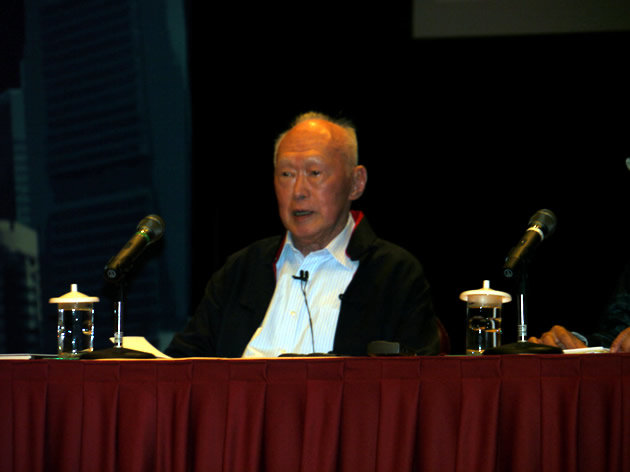
Lee Kuan Yew, five others resign from PAP’s CEC


Former prime minister and co-founder of the People’s Action Party (PAP) Lee Kuan Yew has stepped down from the party’s central executive committee (CEC).

Alongside Senior Minister Emeritus Goh Chok Tong, former PAP chairman Lim Boon Heng, Wong Kan Seng, George Yeo and Lim Hwee Hua, Lee’s resignation from the party was accepted by the CEC at a meeting on Wednesday.

They had "proposed to step down to facilitate leadership renewal in the party", said PAP's second organising secretary Ng Eng Hen in a statement posted on the party website.

To recognise the "outstanding service and seminal contributions" of Lee and Goh to the PAP and Singapore, both were conferred the title of Honorary Past Secretary-General, the party announced.

Party secretary-general Lee Hsien Loong thanked the six outgoing CEC members for their “selfless dedication and sterling service”, noting the key roles they had played in the party over the years, in particular the elder Lee and Goh, who “led Singapore’s progress and transformation through four decades”.

“Leadership renewal in the Party goes hand-in-hand with self-renewal among MPs and Ministers,” the younger Lee, who is Singapore's Prime Minister, added.

"The Party has much work ahead of it to strengthen its roots, extend its outreach, and convince a new generation of voters to support its ideals, vision, and programmes," he said. “This CEC change will enable the Party to induct younger members into the CEC, and form a team which can lead and prepare the PAP for the next general elections by 2016."

To replace the outgoing six CEC members, the party said it will pick new members through a poll of PAP branch chairmen, cadres representing PAP branches, district committees, the Women’s Wing and Young PAP. The selection process is expected to be complete by its convention in November.


.

Sunday, August 28, 2011

S'poreans still value political stability


Tony Tan wins the PE by the narrowest of margins -- a mere 0.34 per cent of total votes. (Yahoo!)
Singaporeans still value political stability and are not quite ready for a President who speaks up more and is an activist, said political analysts Yahoo! Singapore spoke to.
On early Sunday morning, Dr Tony Tan pipped Dr Tan Cheng Bock by slightly over 7,000 votes -- 0.34 per cent -- of total votes in a nationwide poll to become the seventh President of Singapore.
Both candidates were former members of the ruling People's Action Party. Together, the former deputy prime minister and former party backbencher respectively amassed nearly 1.5 million votes out of a possible 2.1 million cast.
Professor Eugene Tan, a lecturer at the Singapore Management University, said it showed that Singaporeans are still not ready to have a President that rocked the boat too much.
"Both Dr Tans were seen as candidates that could work with the Government. Both Dr Tans polled almost 70% of the popular vote.That suggests that the PAP branding for a candidate is not a liability as is widely perceived," he said.
On what were the key factors behind Dr Tan's win, he said, "Dr Tan's experience in public and private sectors and brand recognition from his years as a Cabinet Minister" and the fact that the non-Establishment vote was split between the other three candidates, Dr Tan Cheng Bock, Tan Jee Say and Tan Kin Lian.

Dr Tony Tan is Singapore's seventh President. (REUTERS Photo/Tim Chong)
Tan Jee Say, who said he intended to play the role of "auditor and gatekeeper" if he had won, came in with 25 per cent, or 529,732, of votes, while former NTUC chief Tan Kin Lian garnered less than 5 per cent of votes. The latter is set to lose his election deposit of S$48,000.
"Mr Tan Kin Lian's very poor showing suggests that he will have to reconsider if he has political appeal while for Mr Tan Jee Say, the options are plentiful. He is likely to rejoin opposition politics... and we can expect him to run in the next PE in 2017," added Professor Tan.
Professor Tan also said that Dr Tan Cheng Bock's coming out of political retirement demonstrated that his political currency is still strong but age may not be on his side for the next PE as he will be 77 then.
Gillian Koh, a senior research fellow at the Lee Kuan Yew School of Public Policy, told Channel NewsAsia that there was "not enough strong support" for a president that should speak up more and to initiate discussion of policy issues.
However, another political analyst Dr Reuben Wong cautioned that while Tony Tan's "experience and expertise are valued by voters", he will need to "respond to the concerns of the 60-odd per cent that voted someone else."
Meanwhile, reaction from Singaporean netizens about the results was mixed.
Producer Ben Tan said that he's happy with the result.
"Among the candidates, Tony Tan appears to be the most political savvy although I think that the elections is a bit farcical considering that he or any candidate who wins will have less than 40 per cent of the popular vote," said the 27-year-old.
"I expect him to work closely with the government, ensuring that our past reserves are used only under extraordinary circumstances, and to champion the causes of nation building and integration," Tan added.
26-year-old student Lee Quanta also agreed that Dr Tony Tan deserved to win because "he has been contributing to the nation and you can't deny that he has helped the nation before and is approachable on at international level."
He expects Dr Tan to "uphold the nation and bring changes to the nation and not just be the President for the sake of being one. Be sure to know his stand and what he can do to help the people in the country."


Dr Tan Cheng Bock received loud cheers from his supporters at Jurong East Stadium. (Photo by Nicky Loh/Getty I …
Others online though were upset with the results but still welcomed Dr Tony Tan as the seventh president of Singapore.
"It's indeed sad and unfortunate for Singapore that Dr Tan Cheng Bock did not become our next president. Put nation before politics," User RD commented.
30 something wrote on Yahoo! Singapore's Facebook wall, "The result basically reflects what kind of President Singaporeans want. Half of TCB (Tan Cheng Bock) + Half of TT (Tony Tan). The winner, Tony Tan will have to work towards what TCB portrayed in order to win hearts of voters."
"Regardless of who we voted for, we should stand behind our new President to give him the support he needs to best progress our country," said Sky.


Tan Jee Say won one in four votes and clinched 529,732 votes. (Yahoo! photo/Aeron Chew)
However, a legal secretary who only wanted to be known as Tham, 37, said she is unhappy with the results.
"I want a President that is outspoken and not a puppet" and cited that Tan Jee Say would have been the best choice for President "because he has a humble background and he understands the life led by commoners".
2.27 million Singaporeans were eligible to vote in this year's Presidential Election, the first Presidential Election in 18 years. Total votes received were 2,153,014, inclusive of the 37,826 rejected votes.


Tan Kin Lian conceded defeat at an early stage of counting after visiting three counting centres. (Yahoo! photo/Liyana …
President-elect Tony Tan will be sworn in this Thursday, 1 September. He will replace outgoing SR Nathan and will be Singapore's seventh President.


Tuesday, July 5, 2011

S’poreans have ‘unhealthy level of self-centredness’: SKM survey

[ By Fann Sim | SingaporeScene – Mon, Jul 4, 2011  ]


Survey shows that Singaporeans are harsher on fellow Singaporeans. (Yahoo file photo)

Singaporeans display an "unhealthy level" of self-centeredness and self-absorption in their perception of their graciousness, a survey by the Singapore Kindness Movement (SKM) revealed.

In the third "State of Graciousness in Singapore" survey conducted in January this year, 43 percent of Singapore citizens and PRs rated themselves well in terms of how gracious they are, but when asked to rate the graciousness of other Singaporeans and PRs, only 15 percent gave good ratings.

When respondents were asked if they have done a random act of kindness in the last six months, 88 percent or 876 Singaporeans said they had, but only 55 percent or 553 Singaporeans said they had been on the receiving end of any such act.

The survey covered 1,404 people in Singapore, including 1,001 citizens and permanent residents (PR), 201 work permit and employment pass holders and 201 tourists.

"Singaporeans consistently give harsher assessments of fellow Singaporeans and are more forgiving towards themselves," Dr William Wan, general manager of SKM, said.

"The findings showed an unhealthy level of self-centeredness and self-absorption, and not being aware of and not appreciating the efforts of others. This is the attitude that we want to change," he added.

Most Singaporeans agreed with the statement that they did more kind and gracious acts than unkind and ungracious acts. They also prided themselves on being gracious person and would encourage others to do so.

However, 62 percent or 621 respondents agreed that it was not possible for Singapore to become a more gracious place due to the hectic and stressed lifestyle in Singapore.

What sort of behaviours would tick Singaporeans off?

445 Singaporeans felt that fellow Singaporeans did not display considerate dining etiquette. Singaporeans also listed inconsideration towards others on public transport and failing to display safe lane etiquette while driving as the least gracious behaviour.

Singaporeans also pointed to public transport, public spaces and public eating places as the top three areas that needed the most improvement in the survey.


.

Sunday, June 5, 2011

How did PAP government miss all the signs?


[ extracted from Yahoo.com -By Andrew Loh | SingaporeScene – Sun, Jun 5, 2011 ]

How did the gov't miss all the signs on the ground? (Yahoo! photo/ Fann Sim)(Yahoo! photo/ Fann Sim)


On 28 May, at a dinner to thank People's Action Party (PAP) volunteers, Prime Minister Lee Hsien Loong defended its grassroots leaders and activists from accusations of not having provided proper feedback to the party.

Critics said this shielded party leaders from being cognizant of the unhappiness on the ground surrounding various issues.

However, PM Lee said the fault could lie on party leaders themselves. The Straits Times reported the PM as having said:

"Unfortunately, we may not have picked up and interpreted it correctly, and acted on it the way we should have done, but it's not for lack of trying on the part of the activists."

To pinpoint the communication failure at the party grassroots channels alone would be simplistic and inaccurate. It is not just how feedback from the grassroots were "interpreted" that should be the cause for concern.

The government, and indeed the PAP as well, has many channels to receive and distil feedback -- both within and without the party or government framework. There are the newspapers, the Internet, the Meet-The-People sessions, the much-touted REACH portal, even radio shows and public forums.

The question therefore is: How did the government miss all the signs and was apparently deaf to the alarm bells?


Crux of the matter

One popular reason believed by its detractors, and not without justification, is that government leaders had become arrogant, perhaps believing in their own superior wisdom and dismissing criticisms and genuine feedback as "noise", as one minister put it during the Tin Pei Ling saga.


Having many feedback channels is useless if, at the end of the day, these are not taken seriously.

Thus, it is not about the channels per se or even the processes and procedures in place. It is about the mindsets which government leaders adopt towards criticisms and queries. This really is the crux of the matter. Indeed, the grassroots are not to blame, ultimately.


Ministers, who are themselves MPs in their constituencies, conduct Meet-the-People sessions, too, and interview residents face-to-face. They also speak at public forums.

New Minister of State, Amy Khor, has been and still is in charge of the REACH feedback portal. Ministers too are aware of what is reported in the newspapers and said on the Internet.

So really there is no excuse for not having "interpreted" the sentiment "correctly". After all, even Brigadier-General Tan Chuan Jin, new Minister of State, said he had been aware of the "frustrations, angst" even when he was being considered for candidacy by the People's Action Party for the May elections. "Obviously you hear it from friends, family, so that was something I was very conscious of," he said on Channel NewsAsia.


The problem could lie squarely on the mindsets and attitudes of those at the very top. Consider how government ministers have stoutly, and at times arrogantly, defended their policies when perceived flaws were brought to their attention. 


Sometimes, those who highlight these flaws are scolded and dismissed as "irresponsible", or "daft" and ascribed many other not-so-kind terms.


Obvious issues

There needs to be a change in attitude towards criticism. Ministers must realise that gone are the days when they could hide behind a wall of silence, protected by a compliant media which continuously sing their praises while the masses outside cry out for relief.

Yet, some problems in the last few years were so significant that even if no one brought it to the ministers' attention, he should have known about them anyway.

Consider the sentiment surrounding the housing issue. Many had been expressing unhappiness that prices of public flats were getting beyond their reach. Yet, the minister in charge repeatedly stood his ground and vehemently defended his policies, instead of perhaps taking the feedback seriously and looking into whether there was any truth to them. One newspaper even gave the minister a weekly column to explain why his policies were right even as prices continued to escalate.

The paper would have done better if it had used the print space to highlight to the minister what were wrong with his policies instead.

Another example is the tented homeless communities spread out across public parks in Singapore in 2009 and 2010. How could the Minister for Community Development, Youth and Sports be apparently ignorant of these?

The point here is not about who gives feedback, or the channels available. It is, I would argue, not even about how feedback is "interpreted".


It is ultimately about whether ministers accept that criticisms are important, despite who is making them, and whether it is willing to see and acknowledge that one cannot be right all the time.


It is heartening to know that PM Lee has now embarked on a "reform agenda", as some have put it, and that his new Deputy Prime Minister, Mr Tharman Shanmugaratnam, has set the tone by promising to listen to feedback.

One hopes that his attitude will be an example to his MPs and that they will shed that armour of arrogance once and for all -- the holier-than-thou mindset which drew a most stunning backlash during the recent elections.

[ Andrew is the co-founder of socio-political website The Online Citizen and helmed it for more than four years until June 2011. He also writes frequently on issues which are close to his heart.]


.

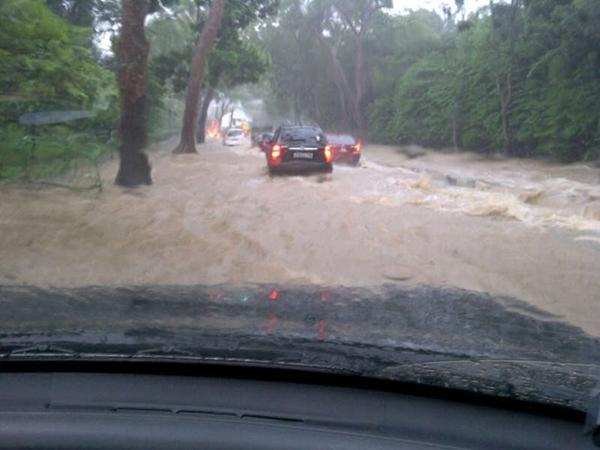
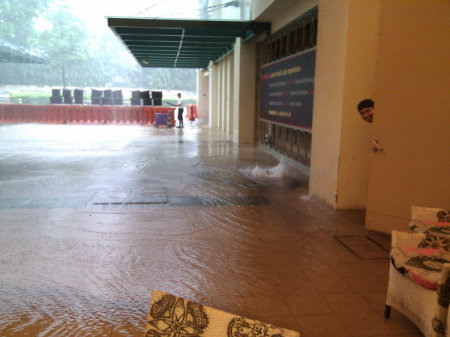
Floods worse this time around (Singapore)


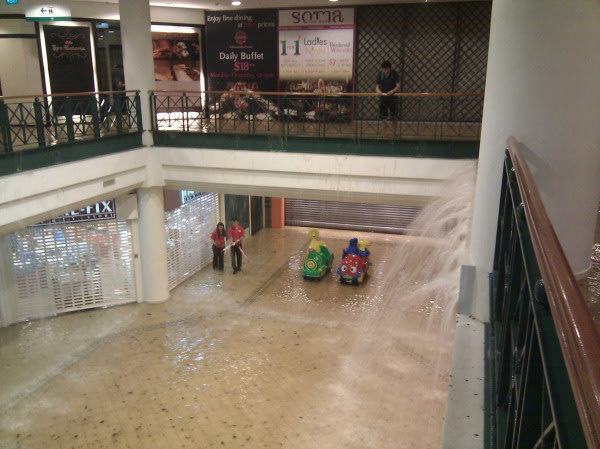
Basement of Tanglin Mall flooded (courtesy of @onglette)Basement of Tanglin Mall flooded (courtesy of @onglette)


Several retail malls along Orchard Road said the flash floods that took place on Sunday morning was worse this time around than last June.

Tanglin Mall was among the hardest hit with several shops having to close temporarily after flood water from Level One , which was at road level, started pouring in.

Within minutes, water fell like a mini-waterfall onto Basement One. Several businesses -- a supermarket, food court and various shops -- were submerged in ankle-deep water and had to close. There was also widespread chaos after the basement carparks were also affected.

"The shop was flooded to about ankle-level and everyone was running around. The car park was flooded (and) cars were stuck. So everyone was frustrated (and) confused," said Family-Com salesperson Dominic Ngiam, as reported on Channel NewsAsia.

Even the St Regis Residences carpark and Forum Shopping Mall were badly affected by the flash floods.

In June 2010, similar floods along Orchard Road cost businesses hundreds of thousands of dollars.

But this time, employees said the floods were worse.

The Little Gym instructor PJ Lucero said on CNA, "The last time it happened, it was actually more mild. We were still able to open the facility for the day. Today (Sunday), of course, everything got submerged, that's why we had to close down.

"In fact, after the first time it happened, we had sandbags ready. We did use those sandbags today (but) it didn't work. The water just went through it".

Chen Jiahui, store manager of Spinelli Coffee Company along Forum Shopping Mall, added, "This is the second time (it flooded). It's really bad, so I hope that the management are doing something about it".

National water agency PUB said the severity of the flood at Tanglin Mall was something it had not seen in the last 25 years.

It said rainfall was more intense than that of June last year, when various parts of Orchard Road were flooded. About 65mm of rainfall was recorded within 30 mins on Sunday morning, compared to 100mm within two hours on June 16, 2010.

Later in the day, at a press conference which was also attended by Minister for the Environment and Water Resources, Vivian Balakrishnan, PUB explained that the flash floods on Sunday morning were caused by two bouts of heavy rainfall.

It said the first bout of rainfall started slightly past 6am, and second downpour, which was more intense, occurred at about 10.30am.

Speaking after inspecting the flood areas at Tanglin Mall, Dr Balakrishnan said, "Personally, I think our weather has changed. I'm actually psychologically prepared for it to get worse."

"You're dealing with nature, and you're dealing with the weather; you have to be prepared that there is a limit to human engineering and what we can deliver, " he added.

"But having said that, let us make sure we have done the best we can and within those limits, then cope with whatever else that nature throws at us."

In a Sunday post on his blog entitled "Focus of floods: 5 Key questions", the Minister also wrote "We are dealing with Nature, and Man needs to be humble when addressing the challenges that Nature poses".

He also admitted that "sometimes despite our best efforts, we cannot win" when dealing with flood issues but he promised that "we will be open and transparent. We will share as much data in real time as possible so that solutions and precautions can be devised for the immediate and long term."

PUB chief executive Khoo Teng Chye, meanwhile, said he is studying some possible solutions to prevent future occurrences.

"These include, possibly, building a big retention pond near where we can then trap some of the peak flows," Mr Khoo said.

"The other alternative is to really create a diversion canal from where this pond is to the Singapore River. But given Singapore's built-up situation, these are very, very expensive schemes."

Eng Neo Avenue flooded (courtesy of @Nadya_HutaGalng)

The heavy downpour early on Sunday also triggered flash floods across several parts of the island. 


Senett Estate, Potong Pasir, MacPherson, Toa Payoh and Bukit Timah were also partially submerged by floods. 

Two lanes along Bukit Timah Road near Cuscaden and Hillcrest Road were completely impassable to traffic at one stage. So too was the Kranji Expressway (KJE) at the slip road towards Woodlands.


Micro-blogging platform Twitter also lit up with hundreds of tweets, shortly after the flash floods (#sgfloods) hit.


Tanglin Mall flooding (courtesy of @onglette) 
Tanglin Mall flooding (courtesy of @onglette)

Ex-model and VJ Nadya Hutagalung (@Nadya_HutaGalng) tweeted, "Eng Neo avenue flooded!"

Another Twitter user Akmal Hadi (@Athrun988) tweeted, "Singapore is gonna be another Venice at the year end monsoon season if the government's not gonna do anything about it soon."

Another user, Jacqui T tweeted, "First world nation with third world drainage system. Wonderful." 

Charlotte Ong (@onglette) also posted a series of pictures of Tanglin Mall flooding and tweeted, "Check out the waterfall in the shopping centre" and "First level flood pouring down to basement." 


.

Thursday, May 26, 2011

Website for Inventors to meet Investors (http://ideas2IP.sg)

Giving Way to Emergency Vehicle

Letter to Heng Swee Keat (Minister of Education, Singapore)

Dear Mr Heng,

The recent polls have triggered many dramatic changes, the biggest of which is PM’s consistent refrain for transformation.   In this spirit, I’m writing to you to ask whole-heartedly for a transformation of our education system.  If not a c...omplete transformation, at least a holistic review of some of the basic tenets by which education policies in this country are made.   As a parent with one child in secondary school and another in primary school with contrasting abilities, I have, over the years, become increasingly frustrated and disturbed by many areas of our education system which I feel are not edifying to the development of children.   At the risk of sounding like one of those domineering, opinionated mothers, let me try to persuade you, from the point of view of a concerned parent, why a change is due.   Education is not a business   Many have felt that Singapore in the past few years has been run like a business and this mindset has filtered down to education.  These days, teachers are ranked against each other measured by KPIs. If their students don't perform up to par, then they drop in ranking. I assume this affects their appraisal and promotion prospects. Principals are also under pressure to keep up in school rankings (and not just in academics), hence they push their teachers to achieve better results.   Here's what happens when schools are run like businesses. Teachers become workers assessed and ranked according to quantifiable output. The principal is like the CEO, answerable to a higher authority based on numbers. Students become products, they are valued only according to the quantifiable output they can contribute, everything else is peripheral or redundant. Everything is reduced to numbers.   Therein lies the problem. When you run a business, the focus has to be on results, preferably quantifiable results. Don't get me wrong, I think it's well and good to try and assess the effectiveness of a school.   But instead of seeing how we can better assess the effectiveness of schools, we run the schools to make them easier to assess.     Education administrators love this because it's so neat, structured and orderly. But the problem is education is about moulding of individuals. And neither individuals nor learning is neat, structured or orderly. The process of education is not and should be like that of manufacturing, taking place in a factory.   A friend of mine who volunteered to lead a character module at her son’s school was taken aback when she was asked for KPIs.  I have other friends who are teachers have expressed frustration at being assessed purely by how well their students score.  If we take this route, there is no "business" value in helping a student overcome his learning disability or giving special attention to a child from a difficult family background because the outcome is not quantifiable. We're leaving it to the assumed social conscience of the teacher and the school to step forward in such instances. But realistically, ensuring ‘A’ students continue to get top grades will likely get priority because it directly impacts on the teacher's KPIs.   Obsession with results   The inevitable outcome of an education system that is run by KPIs is the obsession with results and by this, of course I mean quantifiable results.  What happens then is the focus is shifted from the process of education to the end result of scoring, because that is what is measured in the end.   For example, I find that the way many subjects are taught in schools are based on the marking template, understandably because if the objective is to maximise scores, then you teach to fulfil this objective.  I’m a corporate writer and one of my biggest pet peeves is the way composition writing is taught in primary schools.    Many teachers today are told to mark the language of a composition based on how many "good phrases" are used. In my son’s school, a commercial book of good phrases is part of the syllabus and the kids are told to learn these phrases, even for spelling.  These phrases are often so bombastic and pretentious that nobody in real life would actually use them.  Yet the students are taught them because “ticks” are given for each “good phrase” and added to their vocabulary score.   I remember during a parent-teacher conference, I raised my concerns to my son's English teacher.  To my utter surprise, she agreed with me. She said that once the school started imposing the memorising of good phrases for composition, she ended up with 44 scripts of almost identical introductions (mostly about the "fiery sun in the sapphire sky").  Unfortunately, her hands were tied.   I know why this is imposed - it's to make marking simpler. This way, schools don't have to depend on the arbitrary standards of each marker and the marker just has to follow a matrix. It's certainly more orderly but don't mistake it for creativity. I don't know any other education system which designs its curriculum around the grading. Shouldn't it be the other way around?   To me, attempting to come up with a template for creativity is simply oxymoronic.  Ironically, we’ve managed to suck the creativity out of creative writing.   This obsession with results extends outside of the classroom.  In my daughter’s school, the performing arts groups are given funding according to how well they perform in the SYF.  Likewise, bigger budgets are given to sports that bring in medals. The list goes on. What this breeds in the race for medals and results is that schools often prioritise these over values like effort, sportsmanship and character building.   Even otherwise worthwhile activities, such as CCAs and community service, have lost their noble intent somewhat, as many students now perform these duties clinically for the sake of window dressing their resume.   Valuing people based on academic results   As a direct outcome of a school system that emphasises scores above all else and uses these scores to dictate the child's educational path at a very early age, Singaporeans have become obsessed with chasing grades.  While I don’t deny grades are important, for many, they have become life-centric, meaning kids spend every waking hour performing tasks that will help them better their score.    The mindless pursuit of academic achievement has become so over-arching that many parents are now sending their kids for what I call indiscriminate tuition – tuition in every single examinable subject whether or not the child actually needs it.  My daughter is in an SBGE (School-Based Gifted Education) class and her classmates were either from the GEP in primary school or top scorers in the PSLE.  So I was startled when she told me that most of her classmates have tuition in 3 or 4 subjects.  Tuition has become a crutch - even if the kids are doing well on their own, parents fear the consequences of doing without it.   The backlash is that our children’s self-worth and perception have become intrinsically linked to their academic grades.  Teachers, peers and possibly parents judge the value of students according to their academic ability. I know children whose self-esteem is low simply because they don’t do as well in school as their classmates.  In the “branded” schools, it also breeds elitism because these students deem others less academically-inclined as somehow inferior.  When my daughter attended her first day of school in sec 1, many of her new classmates, meeting her for the first time, didn’t ask “what’s your name?” but “what’s your t-score?”   This treatment of academic prowess as a “superior” skill can be seen throughout our system.  Although we profess to embrace all talents, it’s often lip service.  Prefects and student leaders are usually chosen first on their academic ability before their leadership skills.  In many DSAs for sports, schools still ask for academic results before they will even entertain the child for a trial.  The message we seem to be sending is: we'll look at your other talents IF you have the academic ability.   Putting standards above learning   In my son’s recent p5 mid-year exams, in one class, every single child failed the math paper.  This is a common scenario among some of the popular schools.  Obviously, it’s not because the students are intellectually deficient.  It’s because the papers are often set at a level designed for only the top 25% of kids.  In fact, one question required a method that had not yet been taught to the students.  It’s a mockery of the “teach less learn more” motto – does it mean the teachers teach less but the kids somehow have to learn more on their own?  No wonder tuition centres are flourishing!   I’m tired of hearing the age-old excuse from schools that this will spur the children to work harder.  Incidentally, this is not supported by fact. I suspect it's an urban legend spread by schools who wish to justify their "high" standards.  I meet many parents and students who are more demoralised than "spurred" by their consistently bad results.   What is the point of this? The age gap between my two children is only three years and yet I can see that what my younger child has to learn at his age is markedly more difficult than what his sister had to know.     Perhaps this constant accelerating of the educational syllabus is a knee jerk reaction to the influx of brilliant foreign students, but this is no justification.  We need to recognise that these kids have completely different motivations. They are here purely to study, to carve a better life for themselves, much as our students work harder when they study overseas.  Do we then use these as benchmarks to whip Singaporeans into shape?    No education system is a one size fits all but we need to consider the best interest of the majority of students.  If half your students fail in an exam, it doesn’t reflect badly on the student – it reflects badly on the teaching.  I find that in setting the curriculum and exam papers, there seems to be some semi-sadistic streak in MOE and schools, to trip kids up and make them feel stupid.  It's as if someone is saying, "Aha! I managed to set a question that no one could answer!"  There will always be a small percentage of brainiacs who can ace any exam, no matter how difficult.   That is not a logical benchmark by which to design curriculum or exam papers.   Plea for a more meaningful system  In the course of my work, I had the opportunity to interview the Vice Dean, Education of Duke-NUS.  It was, in my mind, one of the most inspiring interviews I’d ever conducted.  In his words, “We don’t just want the straight ‘A’ student.  Does having one less ‘A’ make you less of a person?  We know Singaporeans are already great at memorising facts – we’re looking for passion, dedication and the ability to see a problem through different angles.”   I feel we could use more of that mindset here. Singaporean educators are often proud of our high standards but let's be honest, we're good at ticking off checklists, exams and competitions. We laugh at the laissez faire American system for its laxity but in truth, they have churned out more innovators and thinkers from their messy system than we have (even after adjusting for size and population).   I will be the first to admit to occasionally suffering pangs of anxiety when my child doesn't do well in an exam because it's hard to stand firm in the onslaught of a tsunami of kiasu-ism.  But at the end of the day, I try to keep reminding myself his character and happiness matter more.  I want a kinder system, one that encourages my child to explore the world around him, not closes it up. One that shows him the richness of issues and topics out there, not limits him to four subjects.   I want a system where I can encourage my child to enjoy music, art, sports for their own sake, and not with the pre-requisite that he does well academically. I want him to want to help others, and not because it counts towards community service hours in his report book. I want to groom a child with integrity and respect towards others, and I hope others can appreciate him for these values.   I am doing as much as I can in these areas but I cannot fight against the education system. I'm writing this in the hope that as you now helm the Education Ministry, you can make the transformation happen.    Thank you very much for your time.


[extracted from an email by : Monica Lim ]

Thursday, April 28, 2011

Mapletree Commercial Trust debuts on Singapore Exchange


SINGAPORE : This year's second-largest initial public offering (IPO) has a flat showing on its first trading day on Wednesday.

Mapletree Commercial Trust opened a tad higher but soon gave up early gains to end at its IPO offer price of 88 cents.

The real estate investment trust (REIT) is the most actively traded counter in the Singapore Exchange during the session, with some 140 million units changing hands.

The counter rose briefly to 89 cents, and reached a high of 90 cents but the buying sentiment fizzled out causing the stock to end its first trading day at 88 cents.

The REIT had offered about 713 million units to institutional and retail investors during its IPO.

REIT manager Mapletree Commercial Trust Management said the total placement tranche and public offer was about 8.38 times subscribed.

The offering of 712.89 million units consist of a placement tranche of 548 million units for institutional investors, and a public offering of 164.8 million units.

Cornerstone investors, including the AIA Group, Hillsboro Capital, Itochu Corporation and NTUC FairPrice Cooperative, have subscribed to a total of 302 million units.

These are separate from the offer.


Distribution per unit for the first year of the Trust's listing (2011/2012) is 4.97 Singapore cents, and 5.42 Singapore cents in the second year (projection year 2012/2013).

The REIT owns VivoCity and office buildings such as the Bank of America Merrill Lynch HarbourFront and PSA Building.

Part of the S$893 million in IPO proceeds will be used to pay for the acquisition costs of the two office buildings.

The proceeds will also be used to fund loans, issue and debt-related costs and working capital.

The IPO follows the mega US$5.4 billion offering by Hutchison Port Holdings Trust (HPH) last month, and the S$3.45 billion offering by Global Logistics Properties late October.

The performance of these two other mega IPOs have been dismal.

At press time, HPH closed trading at 7 per cent below its offer price $1.01 and Global Logistics Properties closed two cents below its IPO price of S$1.96.

- CNA/ch


[ By Linette Lim | Posted: 27 April 2011 2131 hrs]

Monday, March 21, 2011

Mapletree Delays Singapore IPO Launch

SINGAPORE — Mapletree Commercial Trust delayed its planned one billion Singapore dollar (US$789 million) initial public offering in the city-state due to uncertain market conditions, a person familiar with the situation said Tuesday.

Mapletree Commercial Trust — a unit of Mapletree Investments, which is held by state investment firm Temasek Holdings — was looking to raise the money via a real estate investment trust and had planned to file the IPO prospectus with the Monetary Authority of Singapore Monday, the person said.

"They felt that it is prudent to wait and see. They will launch when market conditions are more favorable," the person said.

According to an indicative timetable seen this month, a one-week management roadshow was expected to commence Tuesday with the listing expected April 8.

Mapletree Investments wasn't immediately available for comment.

However, another person familiar with the transaction Tuesday said the trust hadn't yet finalized a new timetable for the management roadshows.

"They are not in a hurry to launch the IPO, because of the volatility in the market. They have good assets so for them the timing is important."

Mapletree is the latest company to fall victim to the uncertain market conditions caused by the destructive earthquake and tsunami in Japan and worsening geopolitical tensions in the Middle East.

In the week after the Japanese earthquake, more than US$4.2 billion of IPOs were put on hold in Hong Kong and Singapore. Among them were a $190 million Hong Kong listing by Chinese oilfield equipment provider Hilong Holding Ltd.; the $3 billion offering of Australia's Resourcehouse Ltd.: the $260 million share sale by Perth-based lithium concentrate miner Galaxy Resources Ltd.; and, in Singapore, the $782.6 million IPO of U.S. private equity group Kohlberg Kravis Roberts & Co.'s engineering group, MMI Holdings.

Even before the Japanese quake, investors were already wary of new issues because of the worsening tensions in the Middle East and growing inflation in Asia.

"They [Mapletree Commercial Trust] are still watching how the situation in Japan is unfolding. If they feel that the market sentiment has improved, they could even launch it next month," the second person said.

The group has appointed Citigroup, DBS and Goldman Sachs global co-ordinators on the offer. CIMB and Deutsche Bank are joint global co-ordinators and bookrunners.

Mapletree Commercial trust's portfolio of Singapore properties is valued at about S$2.5 billion.

Last year, parent Mapletree Investments, which owns and manages about S$13 billion in real estate assets around the world, said it was keen to list its commercial-property unit, whose portfolio includes assets such as Singapore's Vivocity, HarbourFront and the Port of Singapore Authority building.

The plan to list Mapletree Commercial Trust came after the parent listed its industrial property unit, known as Mapletree Industrial Trust Ltd., raising S$1.2 billion in 2010.


[ extracted from The Wall Street Journal ]
[ By SAM HOLMES And P.R. VENKAT ]


SMART Investment and International Property Expo 2011


If you haven't heard by now, there's a property expo coming up this weekend (26-27 March) and it is something property hunters should not miss. The SMART Investment & International Property Expo 2011 will feature international property developers and guest speakers dishing out investment and buying advice. Best of all, it is free to attend.

There will be seminars ranging from buying Singapore property, financing and even some Fengshui forecasting. Interesting eh?


We think it's a good opportunity for both seasoned investors and those who are just starting out to gain valuable insights on making the right property investment. So if you have some time on the weekend, head down to SUNTEC Singapore and become the next property millionaire billionaire!


The SMART Expo press release:


SMART Investment & International Property Expo 2011


The SMART Investment & International Property Expos is Asia’s longest running series of overseas property exhibitions catering for the region’s growing consumer appetite for international real estate. The forthcoming exhibition held on 26-27 March 2011, at SUNTEC Singapore marks the 21st expo since 2004. It retains the theme of offering free educational seminars and an educational platform for investors to acquire residential real estate from around the world.

The 21st expo in Asia, the expo will feature various fabulous lucky draw prizes including the newly released Apple iPad 2, all registered visitors at the expo will be automatically entered in to this draw. Other prizes include a 1 night stay at a luxury lakefront villa in Malaysia, premium wines from Australia, discount and cash coupons from MPH Bookstores (Sinapore), best-selling novels written by various local property experts and many more fantastic items.

The special event will feature property developers coming from Malaysia, Thailand, Australia, UK, USA, and many other countries promoting their luxury property projects and really will be a showcase of the best and most attractive real estate globally. With local property prices soaring to record levels, this has resulted in a huge demand for property bargains overseas and an ever-growing demand by Asia’s wealthiest investors has meant they are able to source and buy international real estate directly at the SMART Expo. According to a recent survey by the Boston Consulting Group, Singapore has the world’s most millionaires per capita. This year, the expo will be led by the Silver sponsors, Leisure Farm and other exhibitors include Logans and Benyapha from Thailand, New York Residence from USA, Walton International from Canada, Rak Investment Authority from UAE, Harvest Time Properties from Australia and many more.

Keynote seminar presenters include President of New York Residence, Thomas Guss; RBS Morgan’s Equity & Derivatives Director, Wai Yee Chen and CEO of Propnex Realty, Mohamed Ismail Gafoor. In total over 25 experts will be giving free investment and international property purchasing advice at SMART.

Lastly, the show will be well supported by various local and regional media outlets. This year, support has come from Singapore’s largest property portal and 2009 winner of CNBC’s “World Best Property Portal”, PropertyGuru; and a host of regional investment and property media, from print to online portals. There are over 20 media partners supporting each SMART exhibition.

All SMART expos are free to attend. Register for free tickets online at www.smartexpos.com/sg

Register now at Asia’s premier international property and investment expo!

Singapore, 26-27 March 2011, SUNTEC Singapore

For more information on exhibiting or visiting, please go to www.smartexpos.com or call +65 6408 9676.


For more, visit the SMART Expo website. To register for free, click here. The SMART Investment & International Property Expo 2011 is at SUNTEC Singapore, Hall 404. Opens from 26-27 March 2011. 11am to 7pm.

Image: SMART Expo


[ extracted fro H88.com ]