British embassies in the eurozone have been told to draw up plans to help British expats through the collapse of the single currency, amid new fears for Italy and Spain. ...
If eurozone governments defaulted on their debts, the European banks that hold many of their bonds would risk collapse.
Some analysts say the shock waves of such an event would risk the collapse of the entire financial system, leaving banks unable to return money to retail depositors and destroying companies dependent on bank credit. ...
Some economists believe that at worst, the outright collapse of the euro could reduce GDP in its member-states by up to half and trigger mass unemployment.
Analysts at UBS, an investment bank earlier this year warned that the most extreme consequences of a break-up include risks to basic property rights and the threat of civil disorder.
“When the unemployment consequences are factored in, it is virtually impossible to consider a break-up scenario without some serious social consequences,” UBS said.
Showing posts with label Markets. Show all posts
Wednesday, November 30, 2011
Brits: Prepare for riots in euro collapse
Prepare for riots in euro collapse, Foreign Office warns - Telegraph
Tuesday, November 29, 2011
Markets move faster than politicians
Which is one big reason why the Euro crisis is not getting solved.
However,
“Financial markets continue to move faster than politicians,” Mansoor Mohi-uddin, head of foreign exchange strategy for UBS, said. “Fixed income investors are betting that either Germany moves towards a fiscal union with its eurozone partners or that, without the ECB willing to buy unlimited amounts of sovereign bonds in the secondary markets, the eurozone will break apart.”This gentleman also says that the end of the Euro as the single, unified European currency has already been priced into the markets. But I would add that the markets have not priced it in all the way.
However,
The EU process continues and the politicians clearly feel they have ample time on their hands.
EU monetary history is full of delays and Germany giving in to pressure. Merkel’s position is under pressure and the Bund Yield has become our barometer for pro-EU solutions – for now the trend is clear – we are on-route to Germany giving up and soon.
Wednesday, July 6, 2011
Mobiles and iPods lead to rise in FM Radio Listeners!

Ever wondering which media is making waves across the Indian sub-continent, not LED or LCDs but it’s the free wave FM Radios, that has been buzzing across students, professionals, or house wives etc.
According to a recent announcement in various FM radio channels, Hansa Research, a pioneer in IRS Survey states that there has been a tremendous rise in the popularity of radio in recent times. According to AP. State Co-ordinator for IRS, Korrapati Venu Gopal, the rising sales of mobile phones, iPods and handheld mini radios, have also led to the rising radio users.
Hansa|GCR, headed by Ashok Das, the founder CEO, once a 13-employee office in India has soon catapulted into a humongous international research organization spread across India and USA and currently employs around 250 employees worldwide.
Interestingly, Radio has become the most notable medium for many commuters in cars, bikes and individuals to keep track of traffic in twin-cities. Moreover, most of them rely on radio as it is the cheapest and free means to listen to breaking news etc.
No doubt, why more and more advertisers are queuing up to radio stations.
Keep watching this space for more news and updates.
Until then, its Venky, Signing Off!
You can contact the author at: businessbanter@gmail.com
Thursday, May 19, 2011
Dettol - Where are you?

The recent spat involving FMCG giant, Reckitt Benckiser, and Modern Retail's heavyweights like Big Bazaar has caused consumers much inconvenience.
If you’ve searched for your favorite Dettol liquid handwash soap recently and ended up not getting the one at a Big Bazaar outlet near you, blame it on Reckitt Benckiser, the Anglo-Dutch FMCG giant, owner of such popular brands as Dettol, Harpic and Airwick among others, whose stubbornness has made sure that modern retailers like Big Bazaar, Reliance Fresh and More stores from AV Birla Retail have either run out of the stocks or are not placing fresh orders for any of its products. Last month, headlines in pink dailies screamed that Kishore Biyani-owned Big Bazaar stores have threatened to boycott products from Reckitt Benckiser as the latter allegedly trimmed retailer’s margins without taking them into confidence. Terming the move an arbitrary one on part of the manufacture, even other outlets had said to follow the suit. And the slugfest between the two parties has resulted into frustration for the consumers who use the brand.
Cashing on the face-off probably, or it might just be a coincidence, Hindustan Unilver has been aggressively promoting its brands like Lifebuoy liquid handwash and Domex at these modern retail outlets some of whom are also aggressively pushing their private labels in these categories as alternatives to RB’s products. For instance, Future Group is promoting its in-store labels like Clean Mate, while More stores are offering Germex as an inexpensive alternative to Dettol. Ditto with Reliance Fresh, which too is stepping up the effort to improve visibility of its personal healthcare private label brand Endurf, thereby confirming the growing significance of India’s modern ratailers, and more importantly, the rising penetration and popularity of private labels.
Though private labels at present contribute less than 10% of overall sales of modern retailers, in general, they are nonetheless expected to pose serious challenge to manufacturers’ brands in the foreseeable future. In developed markets of the US and Europe, modern retail accounts for over two-thirds of overall sales of consumer products while in Asian markets like China their share is about a third. Given the fast-paced growth of modern retail in India it won’t be surprising that the country would soon be able to catch up with at least its neighbors in Asia, which means manufacturers might not be able to continue enjoying their present clout over modern retailers for long. In fact, even in the present scenario, they (manufacturers) risk letting consumers shift loyalty in favor private labels of retailers (which are also planning to make their private labels available at local kirana shops as well), which could do much damage to their brands and have far-reaching impact.
However, at the same time, modern retailers also face the risk of annoying consumers who might not settle for anything other than a manufacturer brand. So, it’s not that by boycotting national brands retailers could have the last laugh as far as gaining consumer loyalty is concerned. Also, though in the past too, there had been instances of spat between retailers and manufacturers (Big Bazaar’s face-off with Kellogg’s and Frito Lay), this time it is different with the emergence of other alternatives like herbal and ayurvedic products in segments like cosmetics, personal care such as soaps, creams and shampoos which are available at only exclusive shops also pose, if not that big, challenge to both the manufacturers’ as well as retailers’ brands.
Given that, finding a middle ground, that too quickly, is just what experts would prescribe and is the need of the hour. After all, ‘consumer is king.’
Amy, Chief Editor.
You can reach the author at chiefeditor@addonviews.com
Tags: Dettol, Health care, Soaps, Skin care, FMCG, Kellogs, Frito Lay, Hindustan Unilver, Lifebuoy, Domex, Reckitt Benckiser, Big Bazaar.
Wednesday, May 18, 2011
Growth Fatigue!: Symbian, on a slide

Even though Symbian maintains its lead over rivals in the worldwide mobile o/s market sweepstake, the gap is narrowing, as latest data from StatCounter suggests.
While Symbian, from Nokia’s stable, might still be the top mobile operating system (O/S) worldwide but its market leadership is surely on wane as the latest data from data analysis agency, StatCounter shows. Symbian’s global market share stood at 30.25%, as on January 31, 2011, down from 34.16% a year ago. It is followed by Apple’s iOS at the number 2 spot with a market share of 25%, down from 33.13% in January 2010. And guess who won at the cost of these two players. While, it may not take much for you to suggest that it’s Google’s Android, there is another surprise winner in Blackberry, of course the gain was comparatively much substantial in case of the former (i.e., Android). Android grew its market share from a meager 4.54% in January 2010 to nearly 15% (14.61% to be precise) while Blackberry’s O/S added 475 basis points to take its tally to 15.03% in January 2011 from 10.28%, a year ago. Symbian vs. others – The gap is narrowing
(January 2011)
Source: gs.statcounter.com
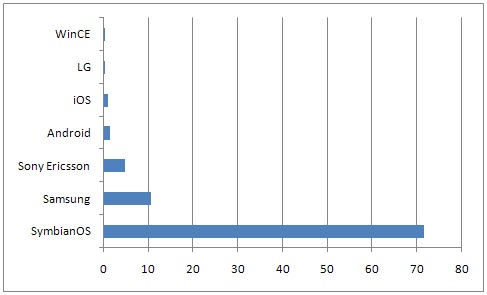
In India too, Symbian rules the roost with a market share of 71.48%, as on January 31, 2011, according to StatCounter. Samsung is a distant second with a market share of 10.6%. Android with a market share of just 1.25% is placed fourth.
India’s mobile o/s market share: Advantage Symbian
(January 2011)
Source: gs.statcounter.com
However, as the StatCounter data shows, Symbian has been losing market share consistently every month since the last one year. But what has surprised market pundits is Nokia’s, which is now led by an ex-Microsoft hand, latest decision to enter into a tie-up with Microsoft and adopt the latter’s Windows 7 o/s.
Does the new development suggest Nokia planning to dump Symbian?
Amy, Chief Editor
Monday, April 25, 2011
Wednesday, April 20, 2011
HCL Tech does it again: Q3 numbers beat the street

Naysayers to India’s fourth largest software giant must be eating a humble pie as HCL Tech’s latest quarterly figures beat analysts’ estimates, once again.
In yet another sign that its highly proclaimed and much wondered about philosophy of ‘employees first, customers second’ is no fad, the New Delhi-headquartered HCL Technology has delivered its third quarter numbers that once again outperform the street’s expectations by significant margins. HCL Tech’s latest result, however, vindicate market analysts’ view that ‘Infosys is no more a benchmark for the Indian IT sector.’
During the third quarter ended March 2011 (the company follows July 1 - June 30 financial year), HCL Tech’s revenue grew 32% YoY to Rs. 4,138 crore; the revenue growth was up 6.4% on a sequential or Q-o-Q basis. The company’s operating profit (EBIT) jumped 17.3% y-o-y to Rs. 597 crore. The biggest surprise, however, was the growth in net income, which crossed $ 100 mn/quarter milestone to reach Rs. 468 crore, which is a jump of 33% y-o-y and 17.1% q-o-q. The street-beating performance comes despite the fact that Jan-March is a seasonally weak quarter as clients remain busy with finalizing budgets for the next financial year. The company also added 1,153 (net additions) to take its total headcount to 73,420.
The robust performance was led by the buoyant IT Services business segment which grew by 6.2% sequentially. HCL Tech also signed 11 transformational deals across service lines, verticals and geographies, during the said quarter. Top 10 clients accounted for a fourth of the firm’s consolidated revenue, while repeat business too remained stable at 94.5%, during the quarter.
In terms of revenues by vertical, Financial Services and Manufacturing accounted for over half (54%) of the total revenues during the quarter while in terms of Geography mix, the company successfully trimmed exposure to the US and Europe while the share of the Rest of the World jumped.
Revenues from onsite software services stood at 27.1% while the rest was accounted for by offshore services, though utilization rate (offshore, including trainees) was lower at 71.9% during the March’11 quarter vs. 76.2% in the same quarter a year ago. In another negative, in the IT Services, the attrition rate too jumped to 17% against about 14% in the same quarter of the previous financial year. However, in the BPO business segment, attrition rate (offshore) nearly halved to 11% from 20.3%, during the same period.
“We continue to expand market share backed by a second sequential quarter of revenue growth of 30%+ YoY along with expansion in margins. HCL’s focus on forward investment in key markets and transformation services is paying rich dividends,” said Vineet Nayar, Vice Chairman and CEO, HCL Technologies. The company’s operating margins expanded by 130 basis points (bps) to 14.4%, during the January-March quarter of FY 2011.
So, is HCL Tech going to be the new poster boy of Indian IT? Lets wait for the results of the two biggies, TCS and Wipro, and the challenger, Cognizant.


Source: Company
Looks like it’s going to be a summer of battles for supremacy at India’s $60bn technology sector.
Amy, Chief Editor
Infy's Leadership Woes:Time for a Checkup!
Infosys of today is no longer the same small, nimble-footed competitor which it used to be a decade ago or earlier and whom rivals would fear. Or, to be fair to Infosys, it might just be a temporary blip in an organization which has been hailed for its impeccable credibility, transparency and global standards of corporate governance not just in India but globally.
Things have changed so dramatically at Infosys, India’s second largest software exporter that even its staunch rivals would find it hard to believe. Till a quarter ago, even though its results fell short of the street’s expectations, most market analysts maintained positive stance on the technology bellwether’s stock, hoping for a turnaround in the forthcoming quarter. However, that was not to be as the fourth quarter result of FY 2010-11 shows. But what is more disturbing is the exodus of two top-level executives: Mohandas Pai, a veteran of 17 years who was touted as its chief firefighter and speculated to be the first non-founder to take the reins of the Bangalore-headquartered firm anytime soon and K Dinesh, one of the co-founders of the company.

Though later in a statement the IT biggie clarified that Dinesh, who will retire by rotation at the company's annual general meeting (AGM) to be held sometime in the coming June, chose not to seek re-appointment, this does not veil the vexed issue of ongoing attrition at the tech giant, attributed largely to the lingering management reorganization (perhaps the former is the fallout of the latter), which led many senior executives to seek better opportunities outside after failing to get larger role in the big organization. Though Wipro, Infy’s cross-town neighbor, too is not better off on this front, as it too has been struggling with similar issues for some time and recently effected an ambitious management overhaul which saw the ouster of its joint CEOs and replaced that with a new CEO structure besides engineering other changes.
Both these firms are now finding it hard to compete with smaller rivals like HCL Tech (which has just declared its March’11 quarter results that comfortably beat analysts’ expectations) and Cognizant, as well as the grand daddy of Indian IT, TCS (you may find the following story interesting: http://businessviewsreviews.blogspot.com/2011/01/stories-abound-about-how-cognizant-is.html).
Expectedly, brokerages, particularly foreign ones, have been quick to downgrade Infosys stock. CLSA, which has downgraded the IT major’s stock to outperform from buy citing concern that the ‘protracted exercise (organizational overhaul) could weigh on company performance for another quarter or two.’ Credit Suisse, another leading brokerages, has downgraded Infosys stock to neutral from outperform, on the concerns over a weak fourth-quarter revenue growth and lower-than-expected margins.

Notwithstanding a slew of downgrades, no one is bearish on Infy for the moment. But then the fact is that it is ageing. But then you ask, so is TCS. That leads us to another issue: TCS is still run by the group patriarch, the maverick Ratan Tata, where as in case of Infosys, it looks like all the co-founders are in a hurry to call it a day, deserting the company at a crucial juncture when it needs their services more than ever. Even in case of Wipro, despite the recent CEO shake-out, the company has not elicited strong reactions from the street as the patriarch Azim Premji remains at the helm of the country’s third largest IT exporter. Also, the Indian IT giants are smaller compared to global peers like IBM and Microsoft. So, all the concerns over ageing and thus decline in growth appear unfounded.
What Infosys needs are entrepreneurs. Though organizational restructuring would take time to fructify, there is a need for the co-founders to be around, acting like a beckon, as they have been for all these years, for the new generation of managers at the helm of the company’s affairs.
Maybe it sounds like we’re a bit more demanding on the co-founders. Probably these are the challenging times Infosys has to go through before the young guns start delivering.
Maybe Infosys can take a leaf or two out of the Team India’s book: Dhoni & Co. achieved through sheer focus and team work minus the earlier flaw of overdependence on individual brilliance.
Down but not out!
Infosys’ stock price
Source: Company
Am, Chief Editor
You can contact the author at businessbanter@gmail.com
Monday, April 18, 2011
Saudis cut oil output
Saudis Slash Oil Output, Say Market Oversupplied:
USO, April 18:
UCO, April 18
One day does not a market make, but oil funds generally ended the day on the uptick.
My guess as to why oil dropped is that the market reacted to the Saudi announcement, but mainly because of this: U.S. credit rating outlook lowered by S&P.
This is not to say that prices will rise again tomorrow. It's the long-term trend that matters most unless you're deliberately a short-term trader (and how do you like them ulcers, eh?). For people with oil funds (not commodity options) in their IRAs, for example, a price drop might be a good buy opportunity since the price outlook for crude oil remains rising over the longer term.
Yes, oil, will continue to rise in price - unless it doesn't: "Potential Black Swan: $10 Oil."
So what will the morrow bring? Sorry, my crystal ball is completely cloudy.
Okay, here's what I think: Gold and silver will fall some (they shot up like a rocket today as investors fled the dollar and oil) and oil and the overall market will rise, but not by a lot.
Saudi Arabia's oil minister said on Sunday the kingdom had slashed output by 800,000 barrels per day in March due to oversupply, sending the strongest signal yet that OPEC will not act to quell soaring prices.This is probably true. Surely no one in the world better analyzes the world oil market better than the Saudis. Oil prices have skyrocketed in the past several months. Most of us probably attribute the rise to unrest in the Middle East, but that is the minority cause. But early this month I covered that:
Consumers have urged the exporters' group to pump more crude to put a cap on oil, which surged to more than $127 a barrel this month, its highest level in 2 1/2 years amid unrest in North Africa and the Middle East.
Oil Ministers from Kuwait and the United Arab Emirates echoed Saudi Arabia's Ali al-Naimi's concerns about oversupply and said rocketing crude prices were out of the hands of OPEC, which next meets in June.
"The market is overbalanced ... Our production in February was 9.125 million barrels per day (bpd), in March it was 8.292 million bpd. In April we don't know yet, probably a little higher than March. The reason I gave you these numbers is to show you that the market is oversupplied," Naimi told reporters.
... the unrest does not account for nearly as much of the price increase as you might think. After all, supplies from the Middle East have remained almost entirely uninterrupted. Egypt's hardly burbled and Libya's disruption accounted for such a tiny proportion of world supply that its effect was marginal. IMO, the oil futures market, which is an aggregated risk assessor, has already discounted the possibility of future unrest regarding supply.The price of oil and of oil funds tanked today. US Oil (USO) dropped from Friday's close of 43.71 to a low today of 42.55 to close at 42.88, a one-day loss of 1.90 percent. Proshares Ultra DJ-UBS Crude Oil (UCO), plunged 3.70 percent from Friday's close of 59.66 to close today at 57.45 after reaching the day's low of 56.54.
No, it seems the real reason oil prices have risen so much is because we, the American people, gave hundreds of billions of dollars to banks that then turned around and put our billions into investments in oil and other commodities funds rather than making loans to businesses. It all started with Ben Bernanke (no surprise)... .
USO, April 18:
One day does not a market make, but oil funds generally ended the day on the uptick.
My guess as to why oil dropped is that the market reacted to the Saudi announcement, but mainly because of this: U.S. credit rating outlook lowered by S&P.
NEW YORK (CNNMoney) -- Standard & Poor's lowered its outlook for the nation's long-term debt Monday, saying the political grousing over the deficit could put more pressure on the still shaky economic recovery.Since oil is (for now) traded in US dollars, the S&P move blasted uncertainty into the market right at the time that the Saudis said they were cutting back. And if there is anything that futures markets hate, it's uncertainty. The initial impulse of investors is to sell, which as trhe graphs show, they did early. But then some sanity returned and prices crept back upward.
"The outlook reflects our view of the increased risk that the political negotiations over when and how to address both the medium- and long-term fiscal challenges will persist until at least after national elections in 2012," said S&P credit analyst Nikola Swann.
S&P maintained its top-tier 'AAA/A-1+' credit rating on U.S. sovereign debt, saying the nation's "highly diversified" economy and "effective monetary policies" have helped support growth. But the ratings agency lowered its outlook for America's long-term credit rating to "negative" from "stable."
This is not to say that prices will rise again tomorrow. It's the long-term trend that matters most unless you're deliberately a short-term trader (and how do you like them ulcers, eh?). For people with oil funds (not commodity options) in their IRAs, for example, a price drop might be a good buy opportunity since the price outlook for crude oil remains rising over the longer term.
Yes, oil, will continue to rise in price - unless it doesn't: "Potential Black Swan: $10 Oil."
Mike Maloney of Gold and Silver Inc. ... said oil would go down to perhaps as low as $10 per barrel (which closely resembles our contention that deflation will cause prices of assets, commodities etc. to fall by 80-90%).But back to the broader markets. Today, after tanking 250 points following S&P's announcement, the Dow recovered to close at -141 from Friday. So apparently the market does not believe that S&P is correct (they didn't shine in their evaluations of Japan, for example).
So what will the morrow bring? Sorry, my crystal ball is completely cloudy.
Okay, here's what I think: Gold and silver will fall some (they shot up like a rocket today as investors fled the dollar and oil) and oil and the overall market will rise, but not by a lot.

Friday, April 15, 2011
Infosys: Is the magic waning?

The lackluster fourth quarter result gives rise to the concern that Infosys magic might be on the wane.
The earnings season, which kick-started today with the IT bellwether Infosys announcing its fourth quarter result, however, has begun on a rather disappointing note. The Nasdaq- and NSE-listed Infy has reported net profit of Rs 1,818 crore during the fourth quarter of 2010-11, which was up 17% year-on-year but lower than analysts’ estimate of Rs. 1,856 crore. The March quarter revenue, which grew 22% to Rs. 7,250 crore, too fell well short of the Street’s expectation of Rs. 7,447 crore. Worse, even the EPS guidance of Rs. 126-128 for the FY 2012 is much below than Rs. 145-150, analysts had projected in a poll by CNBC TV-18.
The Bangalore-headquartered Infosys, founded by legendary N. R. Narayana Murthy along with six other entrepreneurs in July 1981, has had a knack for under-promising but outperforming market’s expectations successfully. However, since the last few quarters, the nation’s second largest technology outsourcer has been failing to repeat the same, causing a sense of resentment across the market participants. “A downgrade is most likely to happen,” warned a visibly disappointed Abhishek Shindadkar, analyst at ICICI Securities in Mumbai, in an interview to CNBC TV18. He added, “An EPS of Rs 150 is out of the way now. We will be surprised if Infosys even manages Rs 140 a share.” Several market analysts have expressed similar views which suggest how Infy disappointed a larger section of the market players.
Another big news that has taken market by surprise is the sudden exit of Mohan Das Pai, the former CFO and a member of the Board of Directors.
Some experts say that Infosys’ tepid performance might signal trouble for the sector. “Based on what Infosys has reported and forecast, people will taper down their earnings estimates for the top players in the sector,” the Economic Times quoted Tejas Doshi of Sushil Finance as saying.
But now a section of analysts say that Infosys is no longer a benchmark for the nearly $60 billion Indian IT sector as they pin hope on behemoth TCS, India’s largest software exporter, and the new IT sensation, Cognizant. Both of these firms had reported better-than-expected results in the preceding quarter.
So let’s wait and watch whether the two can come triumph this time as well or not. Meanwhile, there remain a plethora of challenges before Indian IT sector that includes slow recovery in US and Europe, political unrest in the Middle East, rising wage costs, and above all the currency risks.
Surely, the risks have increased and Indian IT needs to fine-tune its strategies to sustain their growth in a challenging global business environment.
Highlights
- Consolidated results under IFRS for the quarter ended March 31, 2011:
- Revenues were Rs. 7,250 crore for the quarter ended March 31, 2011;
- QoQ growth was 2.0%; YoY growth was 22.0%
- Net profit after tax was Rs.1,818 crore for the quarter ended March 31, 2011;
- QoQ growth was 2.1%; YoY growth was 17.1%*
- Earnings per Share (EPS) was Rs. 31.82 for the quarter ended March 31, 2011;
- QoQ growth was 2.2%; YoY growth was 17.1%*
- 34 clients were added during the quarter by Infosys and its subsidiaries
- Gross addition of 8,930 employees (net addition of 3,041) for the quarter by Infosys and its subsidiaries
- 1,30,820 employees as on March 31, 2011 for Infosys and its subsidiaries
- The Board of Directors recommended a final dividend of `20 per share for fiscal 2011.
* Excluding the income from the sale of our investment in OnMobile Systems, Inc. of `48 crore in fiscal 2010
Source: Infosys
Amy, Chief Editor
Friday, March 18, 2011
Oil: Will it Impact Asia

Spiraling oil prices pose serious threat to growth of Asian economies, notably India and China.
Asian economies, especially India and China might not be able to sustain the growth tempo which has driven the global economy. The ongoing unrest in the Middle East may lead to double inflation rate and growth rates cut across in Asia. Runaway oil prices pose several risks to Asia. High fuel costs could induce slower global growth rate which in turn cuts demand for the region’s exports and would slow domestic consumption in the region. Investors concerns that oil prices could rise further if turbulence spreads to other major oil-producing countries like Saudi Arabia. Oil prices continue to drive equity markets lower across the globe.
Economists warn that China, India, the Philippines, Taiwan, Vietnam and Thailand are at risk from inflation given their high correlation between energy prices and core Consumer Price Index (CPI). Report indicate that if oil prices stay around $120 per barrel, India’s growth rate could fall to 6% from 8.1% and China’s would be cut to 8.8% from 10%. Frederic Neumann and Sherman Chan, economists at HSBC are of the view that “Asian exporters will feel some pain, as could consumers in the region. US consumers, faced with another shock at the pump, will cut back on trips to the mall. Therefore, it all circles back to Asia eventually.” These developments would deprive the global growth driver just as developed countries start to get back on track.
Chart: Crude Oil Prices Movement
Source: www.thisismoney.co.uk
India is one of the top-risk countries in terms of the cost of heavy oil subsidies. The economy could see inflation double to 14% in the coming months from the currently predicted 7.2%. If crude oil prices cross $150 per barrel, Indian government would be forced to deregulate diesel prices. Although the economy is vulnerable to an external oil price shock, but the country’s public sector finances are in a healthy position and growth is fairly robust. However, economists say it a negative, but it is not going to be enough to cause economic recession or to reverse growth in Asian economies. They are optimistic that oil will probably not stay that high, because its sentiment driven, and will probably come down a bit.
However, the UK-based www.liveoilprices.com forecast that oil prices into the spring and summer of 2011 (October 2011 – $150 oil), will go higher than the current $120 per barrel as global oil demand is higher than oil supply and there is another bubble emerging in the oil market. It cites the following two reasons for the same. It further adds “Of course, many short to medium term situations over the world could change this view (Middle East or Asian Conflicts) but most of the potential situations would only make oil prices go even higher. According to the website, the only way oil prices would see a big fall in 2011 would be if the US dollar makes a massive recovery, back to the 90 – 100 level.
Image Source: shawnlazarus.info
Monday, February 14, 2011
Mahindra Satyam’s Q3 PAT grows two-fold, sequentially

In what could probably be the first sign that things are beginning to improve under its new owners, Mahindra Satyam, the erstwhile Satyam Computer Services which was hit hard by the worst accounting scandal in corporate India’s history that came to light in January 2009 and was subsequently acquired by Mahindras in April 2009, has posted robust profit growth, on a q-o-q basis, in the just concluded December quarter of the financial year 2010-11. The Mahindras-owned technology company registered a sequential growth of 152.8% in its consolidated net profit to Rs 58.9 crore in Q3FY11 compared to Rs. 23.3 crore in the immediate preceding quarter i.e., Q2FY11. Although the company’s net revenue grew by just 3% to Rs 1,279.3 crore from Rs 1,242 crore, during the said period.
Yet the results are encouraging given the fact that the company had reported a net loss of Rs 1,250 crore for the FY’10.
“Our efforts of investing in core competencies have begun to show encouraging results. The recognitions that we have received from our partners are true reflections of our inherent capabilities... Mahindra Satyam is geared up for a promising year of growth and opportunities,” said Vineet Nayyar, Chairman, Mahindra Satyam.
CP Gurnani, CEO, Mahindra Satyam, said, “Our key operating metrics are showing an upward trend, and are clear indicators of the improving health of the company. Our recent client wins and rejoining of senior leaders are clear testimony of the Mahindra Satyam promise. We believe that our resilience in meeting business goals with an enhanced focus in strengthening our competencies will ensure that we continue to add significant value to all our key stakeholders.”
The company had 217 clients while its total employee strength stood at 28,832, as at end-December 2010.
Financial Highlights
Financial Highlights under Indian GAAP Consolidated for the Quarter ended December 31, 2010: * Revenue was INR 1,279 crores, up 2.97% QoQ * Operating Profit (EBITDA before exceptional items) was at INR 82 crores * PAT was at INR 59 crores (after exceptional items), up 153% QoQ * EPS (after exceptional items) of INR 0.50 in Q3 as compared to INR 0.20 in Q2 Other highlights for the Quarter ended December 31, 2010 * Consolidated Headcount as on 31st December 2010 was 28,832, up by 764 from 28,068 as on 30 September 2010 * Customer count has gone up to 217 in Q3 * Consolidated cash and cash equivalents were at Rs 3,048 crores, up from Rs 2,996 crores in Q2 FY 11 |
Source: Mahindra Satyam
Friday, February 11, 2011
Tata Motors’ Q3 Consolidated PAT surges 273%

Continuing its good show of the last three quarters since March’10, Tata Motors has once again reported stellar performances in the just concluded December 2010 quarter. India’s largest automobile company which enjoys a unique portfolio of cars – from the mass market Nano to the marque brands like Land Rover and Jaguar – notched up a growth of 273% in its consolidated net profit at Rs. 24.24 billion in Q3FY11 compared to just Rs. 6.5 billion in the same quarter a year ago. The company’s bottom line was boosted by substantial jump in its EBITDA margin which rose to 15.2% from 11.8%, a growth of 340 bps, during the said period. The company’s consolidated net revenue too grew at a healthy 22% to Rs. 316.85 bn in Q3FY11 from Rs. 259.74 bn in Q3FY10.
On a sequential basis, in Q3FY11, the company’s net revenue rose 10.1% while the PAT growth just failed by a whisper to kiss the double-digit mark, registering a growth of 9.1%.
The super fast growth of the company was no doubt driven by JLR, which have continued their good run of show in European markets, as well as global sales, reflected in the fact that the Indian operations accounted for just Rs. 4.1 billion out of the PAT of Rs. 24.24 billion the company earned during the December quarter of FY 2010-11.
However, the automaker’s standalone results for the said quarter are not so impressive with the company registering a growth of a mere 2.5%, y-o-y, in its bottom line during the Q3FY11, though net revenue grew by a little over 28%, during the same quarter. Further, for the 9-month period, the company’s PAT actually declined by nearly a quarter to Rs. 12.38 bn in 9MFY11 from Rs. 16.43 bn in the same period of the previous fiscal year.
According to the company, its Q3 FY2011 Market share increased Q-o-Q to 64.1% driven by improved share of business in MHCV and LCV. The company resorted to average price increases of ~ 1.2 % in Q3 FY11 along with increased cost reduction initiatives to offset increases in costs due to higher commodity prices. Also, Tata Motors gained market share in CV segment Q-0-Q. The 9m FY 2011 market share for commercial vehicles stood at 62.1%. The 9M FY 2011 market share for passenger vehicles stood at 12.7%.
Tables Sources: Tata Motors
Amy, Chief Editor.
Wednesday, February 9, 2011
BPCL Q3 PAT tanks more than 50%
The state-owned oil marketing giant, BPCL’s (Bharat Petroleum Corporation) Q3FY11 PAT more than halved to Rs. 187 crore from Rs. 379 crore in the corresponding quarter of the previous financial year. The company’s net sales, however, grew by 14% on a year-on-year basis to Rs. 36,665 crore compared to Rs. 32,161 crore, during the same period.
Shares of the company declined nearly 2.5% to close at Rs. 584.20 on the BSE.
Amy, Chief Editor
Monday, January 24, 2011
RBI raises key rates by 25 basis points

The country’s central bank today announced its 'Third Quarter Review of Monetary Policy 2010-11' wherein it has hiked both the repo rate and the reverse repo rate by 25 basis points from 6.25 per cent to 6.5 per cent with immediate effect, signaling a tighter interest rate scenario ahead. Though the RBI has left the bank rate as well as the CRR unchanged at 6%.
The following are the highlights of the Monetary Measures announced by the apex bank:
Bank Rate: The Bank Rate has been retained at 6.0 per cent.
Repo Rate: Increases the repo rate under the liquidity adjustment facility (LAF) by 25 basis points from 6.25 per cent to 6.5 per cent with immediate effect.
Reverse Repo Rate: Increases the reverse repo rate under the LAF by 25 basis points from 5.25 per cent to 5.50 per cent with immediate effect.
Cash Reserve Ratio: The cash reserve ratio (CRR) of scheduled banks has been retained at 6.0 per cent of their net demand and time liabilities (NDTL).
ICICI Bank continues strong growth momentum in Q3, change is working

ICICI Bank has reported strong jump in its consolidated net profit during the third quarter of financial year 2010-11. The largest private sector bank in the country notched up consolidated PAT growth of 77.5% Y-o-Y to Rs. 2,039 crore (US$ 456 million) in Q3FY11 from Rs. 1,149 crore (US$ 257 million) in the corresponding quarter of the previous financial year i.e., Q3FY10.
ICICI Bank is India's second-largest bank, after the state-owned SBI, with total assets of Rs. 3,634.00 billion (US$ 81 billion) at March 31, 2010.
The Mumbai-headquartered bank’s standalone net profit was up 30.50% at Rs 1,437 crore versus Rs 1,101.1 crore, during the said period.
The bank’s standalone net interest income grew 12.34% y-o-y to Rs. 2,312 crore in Q3FY11 from Rs. 2,058 crore in Q3FY10.
In another positive, its Current and Savings Account (CASA) ratio increased to 44.2% at December 31, 2010 from 39.6% at December 31, 2009.
Advances too grew by 15.3% Y-o-Y to Rs. 206,692 crore (US$ 46.2 billion) at December 31, 2010 from Rs. 179,269 crore (US$ 40.1 billion) at December 31, 2009.
For live chart: click here
However, the bank’s Operating expenses (including direct marketing agency expenses) increased 27.2% to Rs. 1,707 crore (US$ 382 million) in Q3FY11 from Rs. 1,342 crore (US$ 300 million) in Q3FY10, primarily due to costs relating to new branches added over the last year and full impact of cost of erstwhile Bank of Rajasthan, during the quarter.
Provisions decreased 53.6% to Rs. 465 crore (US$ 104 million) in Q3-2011 from Rs. 1,002 crore (US$ 224 million) in Q3-2010.
The bank’s Net Non-Performing Asset (NPA) ratio also declined to 1.16% at December 31, 2010 from 2.19% at December 31, 2009.
In absolute terms, the bank’s Net NPA decreased by 34.9% to Rs. 2,873 crore (US$ 643 million) at December 31, 2010 from Rs. 4,416 crore (US$ 988 million) at December 31, 2009.
Its Provision coverage ratio increased to 71.8% at December 31, 2010 from 69.0% at September 30, 2010 (51.2% at December 31, 2009).
The bank’s CAR (capital adequacy ratio) stood at a solid 19.98%, with Tier-1 capital adequacy of 13.72%, as per Basel II norms. This is well above RBI’s requirement of total capital adequacy of 9.0% and Tier-1 capital adequacy of 6.0%.
Performance in the 9-Month period of FY 2010-11
The bank’s standalone Profit after tax for the 9-month period of FY 2010-11 grew by 22.5% to Rs. 3,699 crore (US$ 827 million) compared to Rs. 3,019 crore (US$ 675 million) during the same period of the previous fiscal year;
Consolidated PAT for the 9-month period increased by 36.0% to R 4,525 crore (US$ 1.0 billion) for 9M-2011 compared to Rs. 3,328 crore (US$ 744 million) for 9M-2010.
Change@work
According to a statement by the country’s largest private sector lender, it has continued with its strategy of pursuing profitable credit growth by leveraging on its improved fund mix, lower credit costs and efficiency improvement, and cost rationalization. In this direction, the Bank continues to leverage its expanded branch network to enhance its deposit franchise and create an integrated distribution network for both asset and liability products.
ICICI Bank has 2,512 branches, the largest branch network among private sector banks in the country, as on December 31, 2010.
(To read another of our story on ICICI Bank, click here)
Subscribe to:
Posts (Atom)