Showing posts with label National security. Show all posts
Showing posts with label National security. Show all posts
Monday, December 19, 2011
What do you do when your god dies?
Please click here to get to the post. Due to a formatting error, I reposted it.

Saturday, October 22, 2011
Korea, North and South - What? Me Worry?
As in almost everything in foreign affairs, the Obama administration's take on the worsening situation on the Korean peninsula is this:

The president's position toward North Korea is the same as toward Iran: stop doing what I don't like or I will wag my finger at you! The latest example:
And get a grip on that last sentence: "If the North abandons its quest for nuclear weapons and moves towards denuclearization, it will enjoy greater security and opportunity for its people.”
Is our president really that clueless? Yes:
1. The North Korean regime is entirely uninterested in "greater security and opportunity for its people." The North Korean people are slaves, literally. The only security the regime is remotely interested in is of itself. And they know that to possess nuclear weapons is their best guarantee of their own security. Mr. President: it is not the security of the people that motivates the regime. It is the security of the regime that motivates the regime.
2. That being so, you have this year provided an object lesson to the regime (and every other atomic-power tyranny) that whatever they do, they must not under any circumstances give up their nuclear weapons or ambitions. As I wrote last March,
And this week, Mr. president, you gave them photographic proof of what their nukes ensure will not happen to them.
Remember the Iran Plot? I asked at the time, "Is Iran really this stupid?" while fearing that the answer was not about Iran's stupidity but that it has assessed this administration all too well. Michael Ledeen put it on the line:


The president's position toward North Korea is the same as toward Iran: stop doing what I don't like or I will wag my finger at you! The latest example:
On October 13th, President Obama warned the DPRK, with the decisive sternness he commonly uses when dealing with dictatorial and dangerous foreign regimes. There was no suggestion of U.S. military involvement. In essence, he asked that the DPRK stop being nasty if it wants more respect, more goodies, and fewer economic sanctions from the international community — of which the United States is no longer a principal, much less the, leader under his presidency. According to the linked report:Which is to say, Obama said nothing.US President Barack Obama warned North Korea . . . that it would face deeper isolation and international pressure if it carried out more “provocations” like those that rattled Asia last year. Obama, standing side-by-side with South Korean Lee President Lee Myung-Bak at the White House, said Pyongyang could however expect greater opportunities if it lived up to its international obligations over its nuclear program. The two leaders discussed North Korea in their White House talks and said they were united in their approach towards Pyongyang. “Together we’ve succeeded in changing the equation with the North by showing that its provocations will be met not with rewards but with even stronger sanctions and isolation,” Obama said. . . . . ” If the North abandons its quest for nuclear weapons and moves towards denuclearization, it will enjoy greater security and opportunity for its people.”
And get a grip on that last sentence: "If the North abandons its quest for nuclear weapons and moves towards denuclearization, it will enjoy greater security and opportunity for its people.”
Is our president really that clueless? Yes:
1. The North Korean regime is entirely uninterested in "greater security and opportunity for its people." The North Korean people are slaves, literally. The only security the regime is remotely interested in is of itself. And they know that to possess nuclear weapons is their best guarantee of their own security. Mr. President: it is not the security of the people that motivates the regime. It is the security of the regime that motivates the regime.
2. That being so, you have this year provided an object lesson to the regime (and every other atomic-power tyranny) that whatever they do, they must not under any circumstances give up their nuclear weapons or ambitions. As I wrote last March,
The war against Libya has given North Korea and Iran alike every incentive to keep their nuclear programs going at high speed, or even increase the pace. If Qaddafi had maintained his nuke program, would he have had a deliverable warhead by now? We can't know for sure. But had he announced say last year that he possessed even one atomic weapon atop a medium range ballistic missile, France and Italy would never have become so bellicose toward him a month ago.And that same week, "North Korean radio has said that the bombing of Libya proves that North Korea must never give up its nuclear weapons, as Libya did in 2003."
And this week, Mr. president, you gave them photographic proof of what their nukes ensure will not happen to them.
Remember the Iran Plot? I asked at the time, "Is Iran really this stupid?" while fearing that the answer was not about Iran's stupidity but that it has assessed this administration all too well. Michael Ledeen put it on the line:
So, to answer the often-asked question (how could the leaders of the Iranian regime have approved such a provocative action in this country?): they do not fear us, they do not believe that Obama is capable of doing anything that would threaten their grip on power, and they viewed the operation as both a provocation and a humiliation of him and his administration. So far, the pathetic lack of anything approaching a serious response – not even a hint of support for regime change in Tehran — combined with empty ritualistic incantations a la “nothing is off the table” suggest that their assessment is correct.And that is why North Korea takes not the slightest notice of the noises coming from Washington. Odd how this administration's theme song was written in 1968:
Smile an everlasting smile, a smile can bring you near to me.
Don't ever let me find you gone, cause that would bring a tear to me.
This world has lost its glory, let's start a brand new story now, my love.
Right now, there'll be no other time and I can show you how, my love.
Talk in everlasting words, and dedicate them all to me.
And I will give you all my life, I'm here if you should call to me.
You think that I don't even mean a single word I say.
It's only words, and words are all I have, to take your heart away
Tuesday, July 12, 2011
Abolish the TSA and adopt Archie Bunker security
Glenn Reynolds, perhaps only half tongue in cheek, says,
Passengers are the first, and sometimes last, line of defense. Remember Richard Reid, a.k.a. the Shoe Bomber?
ABOLISH THE TSA. TELL PASSENGERS “IF SOMEONE TRIES TO HIJACK THE PLANE, BEAT THE CRAP OUT OF HIM.” WE’D BE BETTER OFF.This was in response to Jeffrey Goldberg's column, "TSA’s Forced Indignities Don’t Make Us Safer." But maybe Archie Bunker had the right idea about 40 years ago.
Passengers are the first, and sometimes last, line of defense. Remember Richard Reid, a.k.a. the Shoe Bomber?
A few minutes later, Moutardier found Reid leaned over in his seat. Her attempts to get his attention failed. After asking "What are you doing?" Reid grabbed at her, revealing one shoe in his lap, a fuse which led into the shoe, and a lit match. She tried grabbing Reid twice, but he pushed her to the floor each time, and she yelled for help, and then ran to get water. When another flight attendant, Cristina Jones, arrived to try to subdue him, he fought her and bit her thumb and Moutardier threw water in his face. The 6 foot 4 inch (193 cm) tall, 200+ pound (90+ kg) Reid was next subdued by several passengers on the airliner, and then bound up using plastic handcuffs, seatbelt extensions, and headphone cords. A physician on board the airliner administered to Reid a tranquilizer that he found in the emergency medical kit of the airliner.And how could you forget Umar Farouk Abdulmutallab, popularly known as the Underwear Bomber who tried to blow up NWA 253 on Christmas Day, 2009?
Abdulmutallab spent about 20 minutes in the bathroom as the flight approached Detroit, and then covered himself with a blanket after returning to his seat. Other passengers then heard popping noises, smelled a foul odor, and some saw Abdulmutallab’s trouser leg and the wall of the plane on fire. Fellow passenger Jasper Schuringa, a Dutch film director, jumped on Abdulmutallab and subdued him as flight attendants used fire extinguishers to douse the flames.[121] Abdulmutallab was taken toward the front of the airplane cabin, was seen to have lost his trousers due to the fire, and had burns on his legs.[122] When asked by a flight attendant what he had in his pocket, he replied: “Explosive device.”But surely we are safe now that the TSA strips 95-year-old, dying women of their Depends.
Friday, May 13, 2011
What Iran aspires to
Lest we get complacent about Iran's accelerating nuclear-weapons program, there is an excellent and sobering photo essay online called, "When We Tested Nuclear Bombs."
 |
| The light shining on the house is solely from the detonation of an atomic weapon. In the next frames, at the link, the house catches on fire from infrared radiation, then is blown to splinters when the blasts' shock wave hits it. |
Saturday, May 7, 2011
Bin Laden, you're so vain, you probably think this raid was about you
SEAL Team 6 captured a number of Osama bin Laden's home videos, among stores of what is described as, "the single largest collection of senior terrorist materials ever," according to "a senior intelligence official," quoted by ABC News.
As the reporter points out, the value of the documents and other materials captured during the raid is astounding. In this war their value can be compared to the breaking of Japan's naval codes during World War II or the Enigma machine that enabled the Allies to read Hitler's signal in near real time. These materials are an intelligence dissection of al Qaeda.
As I have said before, the materials brought from bin Laden's compound are so valuable that they make his death almost incidental to the raid's success. Almost, that is.
Update: Another ABC report:

The government today released five videos found in Osama bin Laden's compound in Abbottabad, Pakistan, showing the al Qaeda leader preparing a message to the United States and watching himself on television. ...
The second video, which runs over a minute long, shows bin Laden watching himself on television and holding the remote control to change the channels between what appear to be Arabic news channels.


As the reporter points out, the value of the documents and other materials captured during the raid is astounding. In this war their value can be compared to the breaking of Japan's naval codes during World War II or the Enigma machine that enabled the Allies to read Hitler's signal in near real time. These materials are an intelligence dissection of al Qaeda.
As I have said before, the materials brought from bin Laden's compound are so valuable that they make his death almost incidental to the raid's success. Almost, that is.
Update: Another ABC report:
U.S. intelligence is now in possession of a veritable "playbook" of al Qaeda operations -- from potential terror attack targets to information on international safe houses and top commanders -- thanks to the Navy SEAL raid that took down Osama bin Laden Sunday, officials told ABC News today.Courtesy my son:
The cache of electronic and handwritten materials obtained by the SEALs includes numerous hallmark al Qaeda plots including attacks on infrastructure targets such as water supply and transportation including rail and air, in what one official described as a "strategic guide for how to attack the U.S." In the past, al Qaeda planned for attacks on water supplies have included an interest in mining dams and in poisoning water supply. Intelligence experts have also have found what appears to be information about safe houses around the world and about al Qaeda leadership.

Friday, May 6, 2011
Let there be - conspiracy theories!
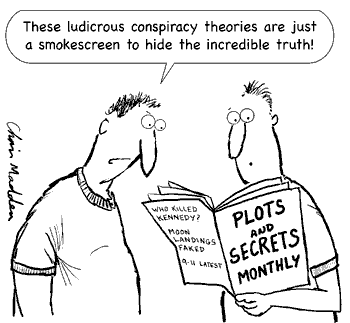
Via American Digest, I find this post by Cobb, "Because he's not dead yet:"
C'mon. You don't get your mitts on Bin Laden just to kill him, and you don't have 40 SEALs who are too slow to tackle the dude. There's is no picture because he's not dead yet. They're twisting him on a spit and slow roasting him until he's so tender the secrets just drip of the bones. They've got him simmering in pentathol. ...Which makes me wonder about the bogus death photos that got shown to some members of Congress.
He's certainly not free or missing, that's for sure. He's never going to see the light of day. But is he dead at this very moment? You will never know.
A day after the White House said it will not release the official photo of Usama bin Laden’s body, many are wondering how a handful of lawmakers were duped into believing they saw it. ...Let us take Cobb's conspiracy theory to its logical limit! I can conspiracy conspire with the best of 'em:
The announcement came after at least three U.S. lawmakers claimed to have seen what they believed was an authentic photograph of Bin Laden, shot in the face and chest during a CIA-led Navy SEALs operation Sunday at a secret compound in Abbottabad, Pakistan.
But those photos appear to have been doctored images sent by an undisclosed source or sources to members of Congress, including Sen. Scott Brown, R-Mass., who admitted Wednesday he’d been fooled into thinking the picture was real.
After telling reporters he had seen an image that confirmed Usama is "definitely dead," Brown later said "the photo that I saw and that a lot of other people saw is not authentic.
Q: Why did the White house dither so long on whether to release photos of bin Laden's corpse and then announce there would be no release?
A: There are no photos of bin Laden's corpse because bin Laden is not a corpse. He was snatched, not killed. The bogus photos that some Members received came from the CIA. They were trial balloons of deliberately faked photos. The "leak" was actually a test of the photos' credibility. It was only after they had been quickly debunked that the White House pulled the plug on using them as "official" photos.
Q: What about the burial at sea?
A: There was no burial at sea off USS Carl Vinson, some of whose officers and crew, including the captain, are part of the conspiracy. As for the SEALs and crews of the Army's 160th SOAR who flew the mission, they won't even tell you what they had for breakfast this morning, much less the respiratory status of a body brought out of a mission objective.
Q: So why the elaborate cover story that OBL was killed?
A: We don't want his successors in al Qaeda to know that OBL, having been waterboarded before 24 hours passed, has spilled his guts just as fully as 9/11's mastermind Khalid Sheikh Mohammed did after he was captured.
Q: Wait! Bin Laden was water boarded? I thought that Obama outlawed that!
A: Yeah, right. Remember, there's an election coming up in only, what 550 days or so. You think that not water boarding OBL is going to stand in the way of a second term? Just wait until the three months before November when we are incrementally fed through a thoroughly compliant media story after story of terrorist plots stopped by analyzing the intel info grabbed during the raid.
And stipulating that all Cobb proposes is true ... does the president know? Or does he really think that OBL is chatting it up right now with Luca Brazzi?
Think it couldn't happen? Remember that naval intelligence actually removed FDR from the distribution list of intercepted, decoded Japanese signals in the months before Pearl Harbor.
The problem with all this, of course, is that "three may keep a secret if two of them are dead." As Chuck Colson, who did prison time for being part of the Watergate coverup, put it, a conspiracy always gets blown, and the more people there are in it, the quicker.
This is exactly why I still insist that proof of OBLs' death must be made public. Not only will it dampen some (not all) of the conspiracy theories already abounding in Muslim lands, failure to do so will make it more likely that similar conpsiracy theories will start to gain credibility here. This must not happen.
For the record: I believe that the SOF operators went into the compound knowing that there was a high likelihood that OBL was there - but that killing or capturing him was not the highest priority of the mission, though high indeed it was. To repeat myself,
The real value of this raid is less the death of bin Laden, as emotionally satisfying as Americans find it, than the trove of materials gathered. ... What the raid did was retrieve enormously important al Qaeda hard drives and documents from Osama bin Laden's house, incidentally killing bin Laden as they did so.Even if bin Laden had not been there, the raid would have been a smashing success because of the intelligence goldmine, the capture of which was surely of no lower priority than confronting bin Laden. But OBL was there. The SEALs killed him. Could they have captured him instead? We'll never know. But dead he is at the close-up hands of the US military. And what's even better, the US Congress authorized it.
Sunday, March 27, 2011
I thought we were done with wars of choice
Barack Obama, June 9, 2009:
US Secretary of Defense Robert Gates, today:
"Now, let me also address the issue of Iraq. Unlike Afghanistan, Iraq was a war of choice that provoked strong differences in my country and around the world. Although I believe that the Iraqi people are ultimately better off without the tyranny of Saddam Hussein, I also believe that events in Iraq have reminded America of the need to use diplomacy and build international consensus to resolve our problems whenever possible."
US Secretary of Defense Robert Gates, today:
Secretary of Defense Robert Gates said that Libya did not pose a threat to the United States before the U.S. began its military campaign against the North African country.So the Obama administration admits that Libya is a war of choice. And here I thought that we were not going to do any more of them. Guess I'm a rube, too.
On “This Week,” ABC News’ Senior White House Correspondent Jake Tapper asked Gates, “Do you think Libya posed an actual or imminent threat to the United States?”
“No, no,” Gates said in a joint appearance with Secretary of State Hillary Clinton, their first since the Libya operation began. “It was not — it was not a vital national interest to the United States, but it was an interest and it was an interest for all of the reasons Secretary Clinton talked about. The engagement of the Arabs, the engagement of the Europeans, the general humanitarian question that was at stake.”
Thursday, March 24, 2011
Libya's ball of confusion
Updates below regarding NATO's pending assumption of command and control
When Operation Odyssey Dawn began, President Obama stated two things very clearly. First was that control of the operation would be turned over to another authority "in a matter of days." Second was that American ground forces would not be sent to Libya.
Well, it's been days now, so let's see where we are on number one. The condensed version is that the Allies are more in disarray than ever. Briefly:
There is a tie-in to the president's other pledge, that US ground forces won't be used. More than anything, this statement proves that not even President Obama sees any significant national interest in Libya, for this pledge is a pledge not to win the war. It is an admission that our aims are limited and that decisive use of force is not on the table. The two pledges, that we won't remain in control of the operation and won't use ground forces, together are a neon sign from the president to the world that we are not seriously engaged in Libya.
It is therefore unsurprising that President Obama, with no sort of military experience or strategic training, has made the same mistake that President Bill Clinton, similarly inexperienced, made in 1993 in Somalia: Great powers should not fight small wars absent compelling national interest. And if they are to be fought, they must be fought quickly and decisively.
Update, 5:30 p.m. CDT: It is now reported that NATO will take command and control of the Libya war.
The devil is in the details, of course, and no details have been announced. As I type, we await Secretary of State Hillary Clinton to come to the microphone to tell us what's going on. I expect that her statements will conceal more than it reveals.
One thing to bear in mind is that to say that NATO will assume command and control really means that C2 will remain in American hands. The Supreme Allied Commander Europe (meaning NATO's commander in chief) is American Admiral James Stavridis. He is responsible to NATO's Military Committee, the highest military authority in NATO, for the overall direction and conduct of military operations for NATO.
The main advantage of keeping C2 in NATO is that the channels of communication, standardization of operations orders and plans and common military terms are well understood by all NATO members. The main disadvantage of turning C2 over to NATO is that the Libya mission has nothing to with NATO's founding purpose and therefore there is nothing in the NATO charter than can be invoked to compel member countries to take part.
So, pending what Sec. Clinton says, Odyssey Dawn will remain an American-run operation.
This seems as good a time as any to ask again, "What has NATO done for us?"
Update: Apparently NATO will take over enforcing the no-fly zone over Libya, but the rest of the UNSC's terms seem to have no change. I am guessing that this was pushed hard and successfully by the French, who have not been reluctant to attack Qaddafi's ground forces (see above) and want to keep doing so. I predict that French President Sarkozy will not place French forces under NATO control.
So NATO-controlled forces will keep Qaddafi's aircraft on the ground or shot down and non-NATO French planes will continue to bust Qaddafi's tanks. This may prevent Qaddafi from wiping out the rebels, but it will not lead to Qaddafi's downfall.
"Starting a war is like entering a dark room blindfolded." It would be well for America's president and other nations' leaders to be mindful of two of Gen. Douglas MacArthur's dicta:
"In war there is no substitute for victory" and, "Prolonged indecision is never a just aim of war."
When Operation Odyssey Dawn began, President Obama stated two things very clearly. First was that control of the operation would be turned over to another authority "in a matter of days." Second was that American ground forces would not be sent to Libya.
Well, it's been days now, so let's see where we are on number one. The condensed version is that the Allies are more in disarray than ever. Briefly:
- The Italians have said that if NATO does not assume overall control, Italy will revoke its permission to use the air bases in the country. I explained the significance of Italy's air bases here.
- However, France insists that NATO not assume control. (Italy accuses France of wanting to set itself up as the leading partner with the Libyan rebels so they will give France priority when exporting oil.) The French say that the intervention should have a coalition partner in charge - meaning "France" of course.
- The British seem just to mumble to themselves about offing Qaddafi, which draws rapid rebukes from US Secretary of Defense Robert Gates. The British apparently want NATO in charge, too, but do not seem to be pressing the issue.
- Then there are the Germans. More properly, one German: Chancellor Angela Merkel, facing a critical election shortly with a large portion of the electorate firm pacifists. She just ordered German naval vessels to withdraw from the coalition naval group offshore Libya. She also ordered German AWACS crewmen not to participate in missions supporting Odyssey Dawn.
- Just yesterday, NATO ambassadors adjourned their meeting on the issue without reaching any kind of basis to resolve the command and control issue.
- What is the primary strategic objective that the United States will achieve through military forces that cannot be obtained otherwise?
- What are the conditions of success in Libya? What must happen before American combat forces are withdrawn? In other words, how will you know when you've won?
Senator Richard Lugar of Indiana, the top Republican on the Senate Foreign Relations Committee, yesterday called for congressional hearings on the mission as U.S. and allied warplanes continued to strike Qaddafi’s ground forces.Speaker of the House John Boehner has finally awakened from his political slumber to send a letter to the president.
“The administration has not adequately defined the U.S. strategic interest in Libya or adequately articulated how the conflict ends,” Lugar said in a letter to the panel’s chairman, Democratic Senator John Kerry of Massachusetts.
He said in his letter that the U.S. public needs to know “what our national security interests are” in the mission “and how it fits into our overarching policy in the Middle East.” These concerns, he said, “point to a fundamental question: What is your hallmark for success in Libya?”Except that the administration has not answered them. Meanwhile, coalition warplanes are now conducting air strikes agaunst Qaddafi's forces threatening the rebel-held, western city of Misrata. The pretense of the air strikes is that government formations are threatening civilians,and so UNSC Resolution 1973's provisions more or less automatically kick in. (That Qaddafi's army is also about to destroy the rebel fighters there seems to be both coincidental and inconsequential.)
Asked about Boehner’s letter today, White House press secretary Jay Carney told reporters that “we have answered a lot of those questions and will continue to answer them.”
Military commanders have said the focus of U.S. and coalition air patrols had shifted from only enforcing a no-fly zone to hitting the regime's ground forces where they are poised to attack civilians."No fly zone," eh? Yes, against the famous Libyan flying mechanized combat vehicles, one supposes. No wonder that respected analyst Anthony Cordesman of the Center for Strategic and International Studies, said yesterday that "essentially, the no-fly zone is not going to succeed."
Strike aircraft, the military official said, "continue to look for opportunities to target regime ground-based mechanized forces and command-and-control facilities."
The no-fly zone imposed by the coalition doesn't solve the rebels' challenges on the ground. "The problem the rebels have is that simply stopping Gaddafi from flying a limited number of helicopter and fighter sorties a day, didn't give the rebels tanks, artillery, discipline or the ability to plan and execute operations, as distinguished from essentially swarming an area and causing a popular uprising," he says. "They remain very vulnerable to ground action."So the poser for coalition leaders, meaning President Obama, is whether they are going to creep the mission from the UN resolution to actually using air power tp help the rebels defeat Qaddafi's forces. As I wrote last Sunday,
If indeed we want the rebels to succeed in taking over governance of the whole of Libya, instead of the rump state it claims to have established in the eastern part of the country, then the Allies' air forces must play the same role there that the US air forces played in the first months of the Afghanistan campaign: be the air force of the indigenous army to support its offensive operations of the anti-government army.Cordesman's assessment?
However, Afghanistan's anti-Taliban Northern Alliance had significant advantages over the Libyan rebels. First, the Northern Alliance had a unified chain of command and years of experience, neither of which the Libyan rebels have. The Northern Alliance was already recognized in the world as the legitimate government of the whole of the country, including occupying Afghanistan's UN seat, while the Libyan rebels have no such advantage or existing legitimacy. The Northern Alliance was Muslim but not in the slightest Islamist; Islamist Talibanism was what they were fighting. And the Libyan rebels? Far from clear.
The rebels are too under-equipped and under-trained to prevail over Gaddafi's mediocre, but more powerful, forces, he says. "So what we have, basically, are rebels that have a great deal of enthusiasm and who are willing to risk their lives, but don't have discipline or structure," Cordesman says. "In case after case, it's clear that when they do have officers present, they won't pay proper attention, they won't show sufficient discipline to carry out maneuvers that are even very simple -- either in advancing or retreating."A joke going around Washington is that President Obama just flew into the United States for a visit and it is hoped that he might stay a few days.
There is a tie-in to the president's other pledge, that US ground forces won't be used. More than anything, this statement proves that not even President Obama sees any significant national interest in Libya, for this pledge is a pledge not to win the war. It is an admission that our aims are limited and that decisive use of force is not on the table. The two pledges, that we won't remain in control of the operation and won't use ground forces, together are a neon sign from the president to the world that we are not seriously engaged in Libya.
It is therefore unsurprising that President Obama, with no sort of military experience or strategic training, has made the same mistake that President Bill Clinton, similarly inexperienced, made in 1993 in Somalia: Great powers should not fight small wars absent compelling national interest. And if they are to be fought, they must be fought quickly and decisively.
Update, 5:30 p.m. CDT: It is now reported that NATO will take command and control of the Libya war.
Navy Adm. William Gortney told reporters Thursday that the U.S. role predominantly would be in support of allied partners, with refueling missions, surveillance, reconnaissance and other noncombat flights. He also said that he expects U.S. planes would continue flying some strike missions.I have written that the Libya war is illegal under the US Constitution, and that "I'd be more than happy if the US role never included actual, direct military action and was limited to logistic, intelligence and transportation support. It's the Euros who've been propping Qaddafi up all these many years, France in particular. So they can have it." Still think so.
The devil is in the details, of course, and no details have been announced. As I type, we await Secretary of State Hillary Clinton to come to the microphone to tell us what's going on. I expect that her statements will conceal more than it reveals.
One thing to bear in mind is that to say that NATO will assume command and control really means that C2 will remain in American hands. The Supreme Allied Commander Europe (meaning NATO's commander in chief) is American Admiral James Stavridis. He is responsible to NATO's Military Committee, the highest military authority in NATO, for the overall direction and conduct of military operations for NATO.
The main advantage of keeping C2 in NATO is that the channels of communication, standardization of operations orders and plans and common military terms are well understood by all NATO members. The main disadvantage of turning C2 over to NATO is that the Libya mission has nothing to with NATO's founding purpose and therefore there is nothing in the NATO charter than can be invoked to compel member countries to take part.
So, pending what Sec. Clinton says, Odyssey Dawn will remain an American-run operation.
This seems as good a time as any to ask again, "What has NATO done for us?"
Update: Apparently NATO will take over enforcing the no-fly zone over Libya, but the rest of the UNSC's terms seem to have no change. I am guessing that this was pushed hard and successfully by the French, who have not been reluctant to attack Qaddafi's ground forces (see above) and want to keep doing so. I predict that French President Sarkozy will not place French forces under NATO control.
So NATO-controlled forces will keep Qaddafi's aircraft on the ground or shot down and non-NATO French planes will continue to bust Qaddafi's tanks. This may prevent Qaddafi from wiping out the rebels, but it will not lead to Qaddafi's downfall.
"Starting a war is like entering a dark room blindfolded." It would be well for America's president and other nations' leaders to be mindful of two of Gen. Douglas MacArthur's dicta:
"In war there is no substitute for victory" and, "Prolonged indecision is never a just aim of war."
Monday, March 7, 2011
John Kerry agrees with me on Libya
Well, there's a snowball fight going on in Satan's realm: Sen. John Kerry and I agree on something. The subject is Libya and what to do about shutting down Qaddafi's air force.
At Foreign Policy, Thomas Ricks has some read-worthy posts. Start with, "Six considerations for discussing the imposition of a Libyan no-fly zone," which posits some very good questions that should be answered before launching the first airplane.
The read, "What Obama needs to do with Libya -- and with the Joint Chiefs of Staff, today," which looks at other options.
He contradicted Defence Secretary Robert Gates, who condemned "loose talk" about a no-fly zone last week, saying it amounted to military intervention. "A no-fly zone begins with an attack on Libya to destroy the air defences," Dr Gates told a congressional committee hearing.Well, give the 2004 Democrat presidential nominee credit, although a little late to the party. I wrote six days ago.
Speaking on CBS, Senator Kerry said: "That's actually not the only option for what one could do. One could crater the airports and the runways and leave them incapable of using them for a period of time."
Crater their runways from one end to the other and the problem is solved. Carriers, while desirable, useful and highly symbolic for long-term commitment, are not necessary to get this job done. Sky park a few Predator UAVs above the airfields so that if Libyan engineers try to repair the craters, we will know immediately - and the Predators can launch disincentives. For that matter, we can crater the runways again and maybe bomb a few pilots' barracks as encouragement.Unlike the senator, I am not gung-ho about the mission - my post was about the military problem itself, not on whether it would be wise to do it. In fact, I would not support that action for reasons I outlined here:
Bombing Libya, even as comparatively "gently" as merely cratering its bases' runways, is also unambiguously an act of war, period. It absolutely places the United States on the side of the rebels, in coercive opposition to their foes. But who are the rebels? Frankly, we just don't know enough about them to be confident that once they gain power they will be much of an improvement over Qaddafi. The "rebel alliance" (sorry, Mr. Lucas!) is mostly an inchoate alliance of convenience among a number of anti-Qaddafi groups. But once Qaddafi falls - if he does fall - who will replace him and what will they be for? ...Senator John McCain weighed in, too,
Libya is embroiled in civil war. While there is certainly no reason to shed a tear for Qaddafi's passing, if he does, I see no particular reason to align ourselves with his potential successor(s), whomever he/they turn out to be. Despite the breathless media characterizations of the demonstrators and newly-formed rebel force as "pro-democracy," there is no evidence that that is what they are. They are justifiably anti-Qaddafi, but that sure doesn't make them democrats (although one may hope).
If the US and its allies are not willing to go all the way and actually effect regime change in Libya, a no-fly operation is pointless. But downfalling Qaddafi will be harder than we might think and require more commitment of treasure and blood than we should be willing to make.
Sen. John McCain, R-Ariz., ranking Republican on the Senate Armed Services Committee, agreed that sending in ground troops would be an inappropriate display by the U.S., but implementing a no-fly zone would not be difficult because Libya's air defenses "are somewhat antiquated."McCain is clearly endorsing using military violence mostly as a symbol: to "signal" Qaddafi. His comments are a ringing endorsement of halfway measures (if even halfway) that surely our experience of the last decade should convince us not to do.
Speaking on ABC's "This Week," McCain said it would send a signal to the embattled Qaddafi "that the president is serious when he says we need for Qaddafi to go. And also, it would be encouraging to the resistance, who are certainly outgunned from the air."
At Foreign Policy, Thomas Ricks has some read-worthy posts. Start with, "Six considerations for discussing the imposition of a Libyan no-fly zone," which posits some very good questions that should be answered before launching the first airplane.
The read, "What Obama needs to do with Libya -- and with the Joint Chiefs of Staff, today," which looks at other options.
Thursday, March 3, 2011
No-Fly for Libya goes a-glimmering
There are some serious issues that need to be faced before the United States or its allies establish a no-fly regime over Libya by that country's air force. Britain's Prime Minister David Cameron called for such a regime to be established just this week, but rapidly beat a retreat when US President Barack Obama did not join the chorus and the proposal drew tepid endorsement, at best, from Britain's military chiefs.
I do not understand why Secretary Gates told Congress that major, sustained attacks against Libya's air defenses and associated infrastructure would be necessary. Perhaps he envisions a mission of destroying Libya's air force and/or constant patrolling above Libya in the same way we and the UK patrolled above Iraq for almost 10 years after the Gulf War. But that would be insane, frankly.
No, if I was the Commander in Chief, my mission assignment to DOD would be simply stated: "You will employ the air forces of the United States, in coordination with allied forces, to prevent the Libyan air force from using its aircraft to attack Libyan opposition forces or civilians."
That's it. I believe that if the mission is so stated, the military problem of rendering Libya's air force incapable of attacking Libyan rebels and demonstrators actually is not very complex.
However, the military problem is not the main one. As with most employments of the blunt national instrument of military force, the real problem is, "what next?" Joshua Keating explains succinctly that simply immobilizing Libyan jets might accomplish very little in suppressing Qaddafi's murderous operations against his own people.
Bombing Libya, even as comparatively "gently" as merely cratering its bases' runways, is also unambiguously an act of war, period. It absolutely places the United States on the side of the rebels, in coercive opposition to their foes. But who are the rebels? Frankly, we just don't know enough about them to be confident that once they gain power they will be much of an improvement over Qaddafi. The "rebel alliance" (sorry, Mr. Lucas!) is mostly an inchoate alliance of convenience among a number of anti-Qaddafi groups. But once Qaddafi falls - if he does fall - who will replace him and what will they be for?
It could be argued that if our use of force makes it possible for the rebels to prevail, then we will have truck with the next Libyan government that will enable us to shape its nature. My response: Well, Herr von Bismarck, I thought you died long ago and took Realpolitik with you. Such an expectation is the triumph of naive hope over centuries of experience in northern Africa. To wit:
Libya is embroiled in civil war. While there is certainly no reason to shed a tear for Qaddafi's passing, if he does, I see no particular reason to align ourselves with his potential successor(s), whomever he/they turn out to be. Despite the breathless media characterizations of the demonstrators and newly-formed rebel force as "pro-democracy," there is no evidence that that is what they are. They are justifiably anti-Qaddafi, but that sure doesn't make them democrats (although one may hope).
If the US and its allies are not willing to go all the way and actually effect regime change in Libya, a no-fly operation is pointless. But downfalling Qaddafi will be harder than we might think and require more commitment of treasure and blood than we should be willing to make.
Britain has backtracked from its belligerent military stance over Libya after the Obama administration publicly distanced itself from David Cameron's suggestion that Nato should establish a no-fly zone over the country and that rebel forces should be armed.US Secretary of Defense Robert Gates testified to a Congressional subcommittee,
As senior British military sources expressed concern that Downing Street appeared to be overlooking the dangers of being sucked into a long and potentially dangerous operation, the prime minister said Britain would go no further than contacting the rebel forces at this stage.
"Let's call a spade a spade," Gates said at a House Appropriations subcommittee hearing. "A no-fly zone begins with an attack on Libya to destroy the air defenses."Adm. Mullen seems unaware that Moammar Qaddafi's son, Saif al-Islam Qaddafi, has confirmed air raids against rebels at Brega.
He added that it couldn't be done by a single aircraft carrier off the coast.
"It's a big operation in a big country," Gates said.
On top of that, Adm. Mike Mullen, the chairman of the Joint Chiefs of Staff, told the same subcommittee that the Pentagon has no confirmation that Libyan strongman Muammar al Qaddafi is using his air force to kill civilians.
In an interview with Sky News, Saif said: "First of all the bombs (were) just to frighten them to go away. Not to kill them."Well, okay then!
I do not understand why Secretary Gates told Congress that major, sustained attacks against Libya's air defenses and associated infrastructure would be necessary. Perhaps he envisions a mission of destroying Libya's air force and/or constant patrolling above Libya in the same way we and the UK patrolled above Iraq for almost 10 years after the Gulf War. But that would be insane, frankly.
No, if I was the Commander in Chief, my mission assignment to DOD would be simply stated: "You will employ the air forces of the United States, in coordination with allied forces, to prevent the Libyan air force from using its aircraft to attack Libyan opposition forces or civilians."
That's it. I believe that if the mission is so stated, the military problem of rendering Libya's air force incapable of attacking Libyan rebels and demonstrators actually is not very complex.
Crater their runways from one end to the other and the problem is solved. Carriers, while desirable, useful and highly symbolic for long-term commitment, are not necessary to get this job done. Sky park a few Predator UAVs above the airfields so that if Libyan engineers try to repair the craters, we will know immediately - and the Predators can launch disincentives. For that matter, we can crater the runways again and maybe bomb a few pilots' barracks as encouragement.Or turn the runway-neutralization mission over to the US Air Force's 509th Bomb Wing with its B2 Stealth bombers. I think Libya's air defenses threat would be pretty much nil.
However, the military problem is not the main one. As with most employments of the blunt national instrument of military force, the real problem is, "what next?" Joshua Keating explains succinctly that simply immobilizing Libyan jets might accomplish very little in suppressing Qaddafi's murderous operations against his own people.
In any case, while a no-fly zone could presumably prevent Qaddafi's planes from firing on protesters or rebel forces, it would do nothing to stop his ground forces and mercenaries from continuing their assault. Given the limited utility then, the U.S. and its allies must now decide if all the trouble involved in setting up a zone -- including inevitable questions of legality -- are worth the risk.That is indeed a problem, but not the only one and not really even the main one, which is this, I think:
Bombing Libya, even as comparatively "gently" as merely cratering its bases' runways, is also unambiguously an act of war, period. It absolutely places the United States on the side of the rebels, in coercive opposition to their foes. But who are the rebels? Frankly, we just don't know enough about them to be confident that once they gain power they will be much of an improvement over Qaddafi. The "rebel alliance" (sorry, Mr. Lucas!) is mostly an inchoate alliance of convenience among a number of anti-Qaddafi groups. But once Qaddafi falls - if he does fall - who will replace him and what will they be for?
It could be argued that if our use of force makes it possible for the rebels to prevail, then we will have truck with the next Libyan government that will enable us to shape its nature. My response: Well, Herr von Bismarck, I thought you died long ago and took Realpolitik with you. Such an expectation is the triumph of naive hope over centuries of experience in northern Africa. To wit:
Dubai: The Libya Revolution Council in Benghazi on Monday warned the US against interfering in the political future of the country and said young revolutionaries will consider hostile any act or attempt to dictate to them who the future leader of the country should be.Who, exactly, is the "Libya Revolution Council?" We don't really know. However, today the imperative to intervene (if there ever really was one) may have passed. Qadaffi and his Venezuelan soulmate, Hugo Chavez, have apparently come up with a plan to end the war.
"There are indications about US efforts to find a new leadership for Libya that is close to the west or accepted by them. Libyans inside the country and abroad will consider such attempts hostile acts against Libyans and attempts to shape the political system in the future will not be tolerated," Ahmad Al Bara'asi, head of media at the newly formed revolutionary council, told Gulf News.
The Venezuelan plan would involve a commission from Latin America, Europe and the Middle East, along with talks between Libyan leader Muammar al-Qaddafi and opposition forces.
"Libya accepts the proposal to work for a negotiated end to the conflict accompanied by an international commission. Venezuela will continue its contacts in the Arab world and elsewhere to find formulas for peace in Libya," Venezuela's Information Minister Andres Izzara tells Reuters.Unsurprisingly, "the chairman of the rebel National Libyan Council rejected proposed talks with Qaddafi," according to reports, whose spokesman said, "We will never negotiate with him."
Al-Jazeera reports that the plan was struck between Qaddafi and Chavez.
Libya is embroiled in civil war. While there is certainly no reason to shed a tear for Qaddafi's passing, if he does, I see no particular reason to align ourselves with his potential successor(s), whomever he/they turn out to be. Despite the breathless media characterizations of the demonstrators and newly-formed rebel force as "pro-democracy," there is no evidence that that is what they are. They are justifiably anti-Qaddafi, but that sure doesn't make them democrats (although one may hope).
If the US and its allies are not willing to go all the way and actually effect regime change in Libya, a no-fly operation is pointless. But downfalling Qaddafi will be harder than we might think and require more commitment of treasure and blood than we should be willing to make.
Subscribe to:
Posts (Atom)